Advertisements
Advertisements
Question
Find the surface area of a sphere of diameter 3.5 cm.
Advertisements
Solution
Diameter = 3.5cm
Radius = `(3. 5cm)/2 -1.75 cm.`
∴ Surface area = `4πr^2 - 4 × 22/7 × (3.5)/(2^2)`
= 38.5 cm 2
RELATED QUESTIONS
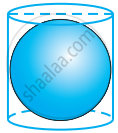
A right circular cylinder just encloses a sphere of radius r (see figure). Find
- surface area of the sphere,
- curved surface area of the cylinder,
- ratio of the areas obtained in (i) and (ii).
A certain number of metallic cones, each of radius 2 cm and height 3 cm are melted and recast into a solid sphere of radius 6 cm. Find the number of cones.
On a map drawn to a scale of 1: 50,000, a rectangular plot of land ABCD has the following dimensions. AB = 6 cm; BC = 8 cm and all angles are right angles. Find:
1) the actual length of the diagonal distance AC of the plot in km.
2) the actual area of the plot in sq. km.
Find the surface area of a sphere of radius 10.5 cm.
Find the surface area of a sphere of radius 14 cm.
The diameter of the moon is approximately one fourth of the diameter of the earth. Find the
ratio of their surface areas.
A hemi-spherical dome of a building needs to be painted. If the circumference of the base of
the dome is 17.6 cm, find the cost of painting it, given the cost of painting is Rs. 5 per l00
`cm^2`
A hollow sphere of internal and external radii 6 cm and 8 cm respectively is melted and recast into small cones of base radius 2 cm and height 8 cm. Find the number of cones.
What is the least number of solid metallic spheres, each of 6 cm diameter, that should be melted and recast to form a solid metal cone whose height is 45 cm and diameter 12 cm?
Determine the ratio of the volume of a cube to that of a sphere which will exactly fit inside the cube.
Find the radius of a sphere whose surface area is 154 cm2.
The hollow sphere, in which the circus motor cyclist performs his stunts, has a diameter of 7 m. Find the area available to the motorcyclist for riding.
Find the volume of a sphere whose surface area is 154 cm2.
Mark the correct alternative in each of the following:
In a sphere the number of faces is
A cone and a hemisphere have equal bases and equal volumes the ratio of their heights is
A cone, a hemisphere and a cylinder stand on equal bases and have the same height. The ratio of their volumes is
Find the surface area and volume of sphere of the following radius. (π = 3.14)
4 cm
If the surface area of a sphere is 2826 cm2 then find its volume. ( π= 3.14)
How many lead balls of radii 1 cm each can be made from a sphere of 8 cm radius?
A sphere has the same curved surface area as the curved surface area of a cone of height 36 cm and base radius 15 cm . Find the radius of the sphere .
A solid metallic cylinder has a radius of 2 cm and is 45 cm tall. Find the number of metallic spheres of diameter 6 cm that can be made by recasting this cylinder .
Find the volume of the hollow sphere whose inner diameter is 8 cm and the thickness of the material of which it is made is 1 cm .
A hemispherical bowl of internal radius 9 cm is full of liquid. This liquid is to be filled into conical shaped small containers each of diameter 3 cm and height 4 cm. How many containers are necessary to empty the bowl?
From a rectangular solid of metal 42 cm by 30 cm by 20 cm, a conical cavity of diameter 14 cm and depth 24 cm is drilled out. Find: the volume of remaining solid
There is surface area and volume of a sphere equal, find the radius of sphere.
There is a ratio 1: 4 between the surface area of two spheres, find the ratio between their radius.
The radius of a sphere increases by 25%. Find the percentage increase in its surface area
The internal and external diameters of a hollow hemispherical vessel are 20 cm and 28 cm respectively. Find the cost to paint the vessel all over at ₹ 0.14 per cm2
