Advertisements
Advertisements
Question
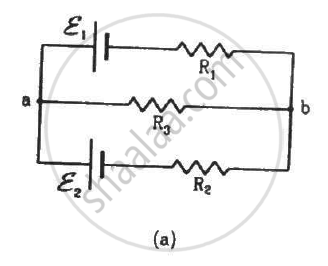
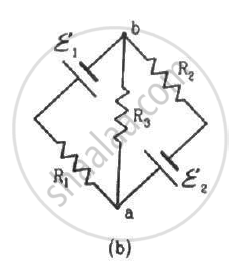
Find the potential difference Va – Vb in the circuits shown in the figure.
Advertisements
Solution
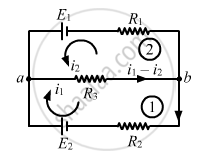
Applying KVL in loop 1, we get:-
\[i_1 R_2 - E_2 + \left( i_1 + i_2 \right) R_3 = 0\]
\[( R_2 + R_3 ) i_1 + R_3 i_2 = E_2 ...........(1)\]
Applying KVL in loop 2, we get:-
\[i_2 R_1 - E_1 + \left( i_1 + i_2 \right) R_3 = 0\]
\[\left( R_1 + R_3 \right) i_2 + R_3 i_1 = E_1 .............(2)\]
Multiplying equation (1) by (R1+R3) and (2) by R3 and then subtracting (2) from (1), we get:-
\[i_1 = \frac{E_2 \left( R_1 + R_3 \right) - E_1 R_3}{\left( R_1 R_2 + R_2 R_3 + R_3 R_1 \right)}\]
Similarly, multiplying equation (1) by R3 and (2) by (R1+R3), and then subtracting (2) from (1), we get:-
\[i_2 = \frac{E_1 \left( R_2 + R_3 \right) - E_2 R_3}{\left( R_1 R_2 + R_2 R_3 + R_3 R_1 \right)}\]
From the figure,
\[V_a - V_b = \left( i_1 + i_2 \right) R_3 \]
\[ \Rightarrow V_a - V_b = \left[ \frac{E_1 R_2 + E_2 R_1}{\left( R_1 R_2 + R_2 R_3 + R_3 R_1 \right)} \right] R_3 \]
\[ \Rightarrow V_a - V_b = \frac{\frac{E_1}{R_1} + \frac{E_2}{R_2}}{\frac{1}{R_1} + \frac{1}{R_2} + \frac{1}{R_3}}\]
(b) The circuit in figure b can be redrawn as shown below:-
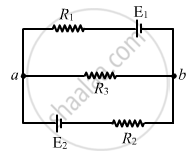
We can see that it is similar to the circuit in figure a and, hence, the answer obtained will be same.
