Advertisements
Advertisements
प्रश्न
Find the potential difference Va – Vb in the circuits shown in the figure.
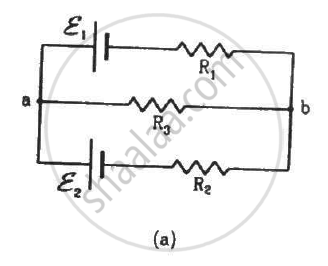
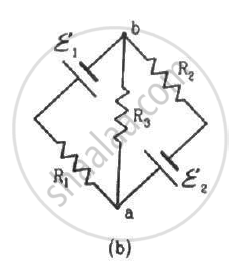
Advertisements
उत्तर
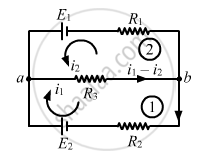
Applying KVL in loop 1, we get:-
\[i_1 R_2 - E_2 + \left( i_1 + i_2 \right) R_3 = 0\]
\[( R_2 + R_3 ) i_1 + R_3 i_2 = E_2 ...........(1)\]
Applying KVL in loop 2, we get:-
\[i_2 R_1 - E_1 + \left( i_1 + i_2 \right) R_3 = 0\]
\[\left( R_1 + R_3 \right) i_2 + R_3 i_1 = E_1 .............(2)\]
Multiplying equation (1) by (R1+R3) and (2) by R3 and then subtracting (2) from (1), we get:-
\[i_1 = \frac{E_2 \left( R_1 + R_3 \right) - E_1 R_3}{\left( R_1 R_2 + R_2 R_3 + R_3 R_1 \right)}\]
Similarly, multiplying equation (1) by R3 and (2) by (R1+R3), and then subtracting (2) from (1), we get:-
\[i_2 = \frac{E_1 \left( R_2 + R_3 \right) - E_2 R_3}{\left( R_1 R_2 + R_2 R_3 + R_3 R_1 \right)}\]
From the figure,
\[V_a - V_b = \left( i_1 + i_2 \right) R_3 \]
\[ \Rightarrow V_a - V_b = \left[ \frac{E_1 R_2 + E_2 R_1}{\left( R_1 R_2 + R_2 R_3 + R_3 R_1 \right)} \right] R_3 \]
\[ \Rightarrow V_a - V_b = \frac{\frac{E_1}{R_1} + \frac{E_2}{R_2}}{\frac{1}{R_1} + \frac{1}{R_2} + \frac{1}{R_3}}\]
(b) The circuit in figure b can be redrawn as shown below:-
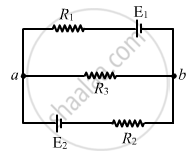
We can see that it is similar to the circuit in figure a and, hence, the answer obtained will be same.
APPEARS IN
संबंधित प्रश्न
In the following potentiometer circuit, AB is a uniform wire of length 1 m and resistance 10 Ω. Calculate the potential gradient along the wire and balance length AO (= l).

In a series LCR circuit, what is the phase difference between VL and VC where VL is the potential difference across the inductor and V c is the potential difference across the capacitor?
Describe the working principle of a solar cell. Mention three basic processes involved in the generation of emf.
Identify the correct options.
(a) An ammeter should have small resistance.
(b) An ammeter should have large resistance.
(c) A voltmeter should have small resistance.
(d) A voltmeter should have large resistance.
The current in a conductor and the potential difference across its ends are measured by an ammeter and a voltmeter. The meters draw negligible currents. The ammeter is accurate but the voltmeter has a zero error (that is, it does not read zero when no potential difference is applied). Calculate the zero error if the readings for two different conditions are 1.75 A, 14.4 V and 2.75 A, 22.4 V.
The potential difference between the terminals of a battery of emf 6.0 V and internal resistance 1 Ω drops to 5.8 V when connected across an external resistor. Find the resistance of the external resistor.
The following figure shows a part of a circuit. If a current of 12 mA exists in the 5 kΩ resistor, find the currents in the other three resistors. What is the potential difference between the points A and B?

A 6-volt battery of negligible internal resistance is connected across a uniform wire AB of length 100 cm. The positive terminal of another battery of emf 4 V and internal resistance 1 Ω is joined to the point A, as shown in the figure. Take the potential at B to be zero. (a) What are the potentials at the points A and C? (b) At which point D of the wire AB, the potential is equal to the potential at C? (c) If the points C and D are connected by a wire, what will be the current through it? (d) If the 4 V battery is replaced by a 7.5 V battery, what would be the answers of parts (a) and (b)?

A copper strip AB and an iron strip AC are joined at A. The junction A is maintained at 0°C and the free ends B and C are maintained at 100°C. There is a potential difference between _______________ .
(a) the two ends of the copper strip
(b) the copper end and the iron end at the junction
(c) the two ends of the iron strip
(d) the free ends B and C
The potential difference across the terminals of a battery of emf 12 V and internal resistance 2 Ω drops to 10 V when it is connected to a silver voltameter. Find the silver deposited at the cathode in half an hour. Atomic weight of silver is 107.9 g mol−1.
A potential difference of 220 V is maintained across 12000 Ω rheostat. Then voltmeter V has a resistance of 6000 Ω and point C is at one fourth the distance from a to b. Then the reading of voltmeter is ______.

In the circuit in figure the potential difference across P and Q will be nearest to

Two sources of equal e.m.f are connected to an external resistance R in series. The internal resistance of the two sources are R1 and R2 (R2 > R1) If the potential difference across the source having internal. resistance R2 is zero, then ______.
