Advertisements
Advertisements
Question
Find out the incorrect statement, if any, in the following:
An angle is formed when we have
- two rays with a common end-point
- two line segments with a common end-point
- a ray and a line segment with a common end-point
Advertisements
Solution
All three statements (a), (b) and (c) are incorrect.
∵ The common initial point of two rays forms an angle.
APPEARS IN
RELATED QUESTIONS
A ray has ______________ end point(s)
In this Figure, ∠AYZ = 45°. If point ‘A’ is shifted to point ‘B’ along the ray, then the measure of ∠BYZ is ____________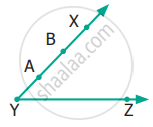
If two rays intersect, will their point of intersection be the vertex of an angle of which the rays are the two sides?
Consider the following figure of line \[\overleftrightarrow{MN}\]. Say whether the following statement is true or false in the context of the given figure.

M is the point on ray `vec"OP"`.
Consider the following figure of line \[\overleftrightarrow{MN}\]. Say whether the following statement is true or false in the context of the given figure.
Ray `vec("OP")` is different from ray `vec("QP")`.
Consider the following figure of line \[\overleftrightarrow{MN}\]. Say whether the following statement is true or false in the context of the given figure.
Ray `vec("OP")` is the same as ray `vec("OM")`.
Consider the following figure of line \[\overleftrightarrow{MN}\]. Say whether the following statement is true or false in the context of the given figure.
Ray `vec("OM")` is not opposite to ray `vec("OP")`.
The fixed point from which a ray begins is called its:
A ray starting from point P and passing through Q is denoted by:
A ray is considered to be:
