Advertisements
Advertisements
प्रश्न
Find out the incorrect statement, if any, in the following:
An angle is formed when we have
- two rays with a common end-point
- two line segments with a common end-point
- a ray and a line segment with a common end-point
Advertisements
उत्तर
All three statements (a), (b) and (c) are incorrect.
∵ The common initial point of two rays forms an angle.
APPEARS IN
संबंधित प्रश्न
A ray has ______________ end point(s)
In this Figure, ∠AYZ = 45°. If point ‘A’ is shifted to point ‘B’ along the ray, then the measure of ∠BYZ is ____________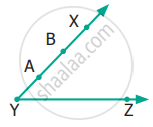
If two rays intersect, will their point of intersection be the vertex of an angle of which the rays are the two sides?
Use the figure to name Four rays.

Consider the following figure of line \[\overleftrightarrow{MN}\]. Say whether the following statement is true or false in the context of the given figure.

Ray `vec("OP")` is different from ray `vec("QP")`.
Consider the following figure of line \[\overleftrightarrow{MN}\]. Say whether the following statement is true or false in the context of the given figure.
Ray `vec("OM")` is not opposite to ray `vec("OP")`.
A ray is defined as:
The fixed point from which a ray begins is called its:
A ray starting from point P and passing through Q is denoted by:
A ray is considered to be:
