Advertisements
Advertisements
Question
Find the equation of a straight line with slope − 1/3 and y-intercept − 4.
Advertisements
Solution
Here, \[m = - \frac{1}{3}, c = - 4\]
Substituting the values of m and c in y = mx + c, we get,
\[y = - \frac{x}{3} - 4\]
\[ \Rightarrow x + 3y + 12 = 0\]
Hence, the equation of the straight line with slope
APPEARS IN
RELATED QUESTIONS
The base of an equilateral triangle with side 2a lies along they y-axis such that the mid point of the base is at the origin. Find vertices of the triangle.
Find a point on the x-axis, which is equidistant from the points (7, 6) and (3, 4).
Find the slope of a line, which passes through the origin, and the mid-point of the line segment joining the points P (0, –4) and B (8, 0).
Find the value of x for which the points (x, –1), (2, 1) and (4, 5) are collinear.
Find the value of p so that the three lines 3x + y – 2 = 0, px + 2y – 3 = 0 and 2x – y – 3 = 0 may intersect at one point.
Find the slope of the lines which make the following angle with the positive direction of x-axis:
\[\frac{3\pi}{4}\]
Find the slope of a line passing through the following point:
(3, −5), and (1, 2)
State whether the two lines in each of the following is parallel, perpendicular or neither.
Through (3, 15) and (16, 6); through (−5, 3) and (8, 2).
Find the slope of a line (i) which bisects the first quadrant angle (ii) which makes an angle of 30° with the positive direction of y-axis measured anticlockwise.
What can be said regarding a line if its slope is zero ?
What can be said regarding a line if its slope is positive ?
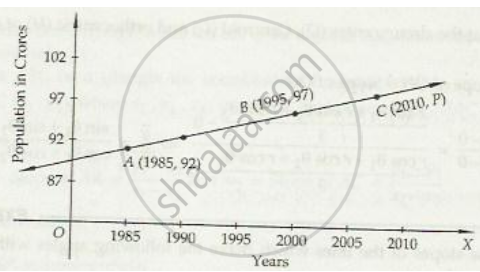
Consider the following population and year graph:
Find the slope of the line AB and using it, find what will be the population in the year 2010.
Without using the distance formula, show that points (−2, −1), (4, 0), (3, 3) and (−3, 2) are the vertices of a parallelogram.
Find the equation of a straight line with slope 2 and y-intercept 3 .
Find the equation of the strainght line intersecting y-axis at a distance of 2 units above the origin and making an angle of 30° with the positive direction of the x-axis.
The line through (h, 3) and (4, 1) intersects the line 7x − 9y − 19 = 0 at right angle. Find the value of h.
Find the image of the point (3, 8) with respect to the line x + 3y = 7 assuming the line to be a plane mirror.
Find the angles between the following pair of straight lines:
3x − y + 5 = 0 and x − 3y + 1 = 0
Find the angles between the following pair of straight lines:
x − 4y = 3 and 6x − y = 11
If two opposite vertices of a square are (1, 2) and (5, 8), find the coordinates of its other two vertices and the equations of its sides.
If m1 and m2 are slopes of lines represented by 6x2 - 5xy + y2 = 0, then (m1)3 + (m2)3 = ?
The equation of a line passing through the point (7, - 4) and perpendicular to the line passing through the points (2, 3) and (1 , - 2 ) is ______.
Point of the curve y2 = 3(x – 2) at which the normal is parallel to the line 2y + 4x + 5 = 0 is ______.
The line passing through (– 2, 0) and (1, 3) makes an angle of ______ with X-axis.
Find the equation of the straight line passing through (1, 2) and perpendicular to the line x + y + 7 = 0.
If the slope of a line passing through the point A(3, 2) is `3/4`, then find points on the line which are 5 units away from the point A.
The equation of the line passing through (1, 2) and perpendicular to x + y + 7 = 0 is ______.
The coordinates of the foot of the perpendicular from the point (2, 3) on the line x + y – 11 = 0 are ______.
Find the equation of a straight line on which length of perpendicular from the origin is four units and the line makes an angle of 120° with the positive direction of x-axis.
If p is the length of perpendicular from the origin on the line `x/a + y/b` = 1 and a2, p2, b2 are in A.P, then show that a4 + b4 = 0.
Slope of a line which cuts off intercepts of equal lengths on the axes is ______.
The tangent of angle between the lines whose intercepts on the axes are a, – b and b, – a, respectively, is ______.
The coordinates of the foot of perpendiculars from the point (2, 3) on the line y = 3x + 4 is given by ______.
Equation of the line passing through (1, 2) and parallel to the line y = 3x – 1 is ______.
Equations of the lines through the point (3, 2) and making an angle of 45° with the line x – 2y = 3 are ______.
The points (3, 4) and (2, – 6) are situated on the ______ of the line 3x – 4y – 8 = 0.
The line `x/a + y/b` = 1 moves in such a way that `1/a^2 + 1/b^2 = 1/c^2`, where c is a constant. The locus of the foot of the perpendicular from the origin on the given line is x2 + y2 = c2.
Line joining the points (3, – 4) and (– 2, 6) is perpendicular to the line joining the points (–3, 6) and (9, –18).
The equation of the line through the intersection of the lines 2x – 3y = 0 and 4x – 5y = 2 and
| Column C1 | Column C2 |
| (a) Through the point (2, 1) is | (i) 2x – y = 4 |
| (b) Perpendicular to the line (ii) x + y – 5 = 0 x + 2y + 1 = 0 is |
(ii) x + y – 5 = 0 |
| (c) Parallel to the line (iii) x – y –1 = 0 3x – 4y + 5 = 0 is |
(iii) x – y –1 = 0 |
| (d) Equally inclined to the axes is | (iv) 3x – 4y – 1 = 0 |
