Advertisements
Advertisements
Question
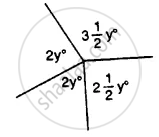
Find each angle shown in the diagram.
Advertisements
Solution
In the figure,
`3 1/2"y"°+2"y"°+2"y"°+2 1/2"y"°=360°` .........(Angles at a point)
⇒ `7/2"y"°+2"y"°+2"y"°+5/2"y"°=360°`
⇒ `7/2"y"°+5/2"y"°+4"y"°=360°`
⇒ `12/2"y"°+4"y"°=360°`
⇒ 6y° + 4y° = 360°
⇒ 10y° = 360°
⇒ y = `(360°)/10` = 36°
∴ ∠AOB = `3 1/2"y"°=7/2"y"°=7/2xx36°`
= 126°
∠BOC = 2y° = 2 × 36° = 72°
∠COD = 2y° = 72°
∠DOA = `2 1/2"y"°=5/2"y"°`
= `5/2xx36°` = 90°
APPEARS IN
RELATED QUESTIONS
Are the following pairs of angles complementary?
37° 28′ and 52° 33′
Are the following pairs of angles supplementary?
139° and 39°.
Three angles which add up to 180° are in the ratio 2 : 3 : 7. Find them.
Find k of the given figure.
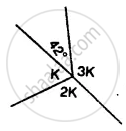
In the given figure, find ∠AOB and ∠BOC.
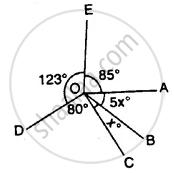
Find K in the given figure.
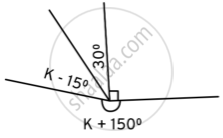
Identify the given pair of angles as ∠2 and ∠4
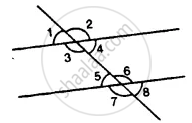
Identify the given pair of angles as ∠3 and ∠7
Identify the given pair of angles as ∠1 and ∠4
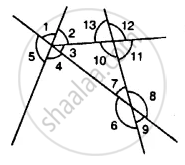
Two angles whose measures are both 45° are:
