Advertisements
Advertisements
Question
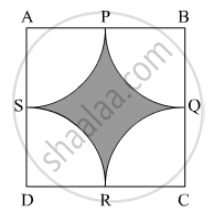
Find the area of the shaded region in Fig. 3, where arcs drawn with centres A, B, C and D intersect in pairs at mid-points P, Q, R and S of the sides AB, BC, CD and DA respectively of a square ABCD of side 12 cm. [Use π = 3.14]
Advertisements
Solution
Area of the shaded region = = Area of the square ABCD − 4 (Area of the quadrant)
`= (12)^2 - 4 x (90^@/360^@ xx pi xx (6)^2)`
`= 144 - 4 xx (1/4 xx pi xx 36)`
`= 144 - 36pi`
= 144 - 36 x 3.14
`= 30.96 cm^2`
APPEARS IN
RELATED QUESTIONS
If the total surface area of a solid hemisphere is 462 cm2 , find its volume.[Take π=22/7]
2 cubes each of volume 64 cm3 are joined end to end. Find the surface area of the resulting cuboid.
A cubical block of side 7 cm is surmounted by a hemisphere. What is the greatest diameter the hemisphere can have? Find the surface area of the solid. [Use `pi = 22/7`]
A toy is in the form of a cone surmounted on a hemisphere. The diameter of the base and the height of cone are 6cm and 4cm. determine surface area of toy?
How many spherical lead shots each of diameter 4.2 cm can be obtained from a solid rectangular lead piece with dimension 6cm \[\times\] 42cm \[\times\] 21 cm.
A solid sphere of radius r is melted and cast into the shape of a solid cone of height r, the radius of the base of the cone is
A hemispherical bowl of internal diameter 30 cm contains some liquid. This liquid is to be poured into cylindrical bottles of diameter 5 cm and height 6 cm each. Find the number of bottles required.
A solid metallic sphere of diameter 21 cm is melted and recast into a number of smaller cones, each of diameter 3.5 cm and height 3 cm. Find the number of cones so formed.
In the figure given below, ABCD is a square of side 14 cm with E, F, G and H as the mid points of sides AB, BC, CD and DA respectively. The area of the shaded portion is ______.

The radius of spherical balloon increases from 8 cm to 12 cm. The ratio of the surface areas of balloon in two cases is ______.
