Advertisements
Advertisements
Question
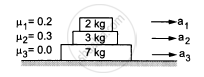
Find the accelerations a1, a2, a3 of the three blocks shown in the following figure if a horizontal force of 10 N is applied on (a) 2 kg block, (b) 3 kg block, (c) 7 kg block. Take g = 10 m/s2.
Advertisements
Solution
Given:
μ1 = 0.2
μ2 = 0.3
μ3 = 0.4
Using the free body diagram, we have: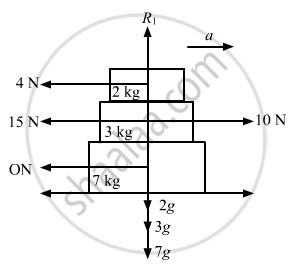
(a) When the 10 N force is applied to the 2 kg block, it experiences maximum frictional force.
Here,
μ1R1 = μ1 × m1g
μ1R1 = μ1 × 2g = (0.2) × 20
= 4 N (From the 3 kg block)
Net force experienced by the 2 kg block = 10 − 4 = 6 N
`therefore a_1=6/2=3 "m/s"^2`
But for the 3 kg block (Fig. 3), the frictional force from the 2 kg block, i.e, 4 N, becomes the driving force and the maximum frictional force between the 3 kg and 7 kg blocks.
Thus, we have:
μ2 = R2 = μ2m2g = (0.3) × 5 kg
= 15 N
Therefore, the 3 kg block cannot move relative to the 7 kg block.
The 3 kg block and the 7 kg block have the same acceleration (a2 = a3), which is due to the 4 N force because there is no friction from the floor.
`therefore a_2=a_3=4/10=0.4 "m/s"^2`
(b) When the 10 N force is applied to the 3 kg block, it experiences maximum frictional force of (15 + 4) N, i.e., 19 N, from the 2 kg block and the 7 kg block.
So, it cannot move with respect to them.
As the floor is frictionless, all the three bodies move together.
`therefore a_1=a_2=a_3=10/12=(5/6) "m/s"^2`
(c) Similarly, it can be proved that when the 10 N force is applied to the 7 kg block, all three blocks move together with the same acceleration.
`therefore a_1=a_2=a_3=(5/6)"m/s"^2`
