Advertisements
Advertisements
Question
Figures show the physiography of India and Brazil. Use the maps and the indices to answer the following.
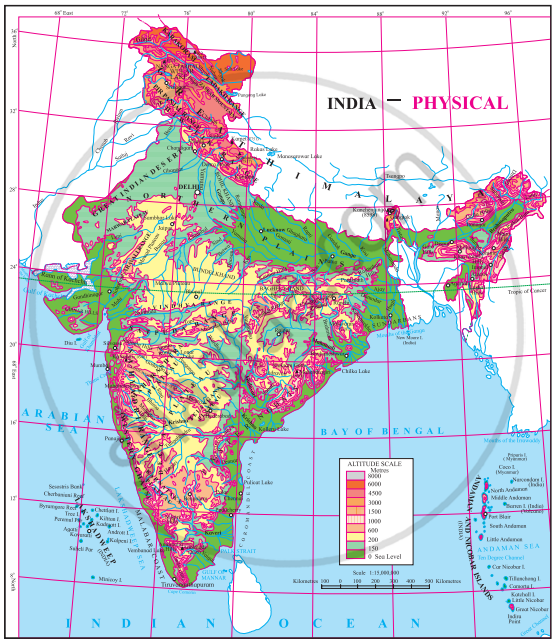
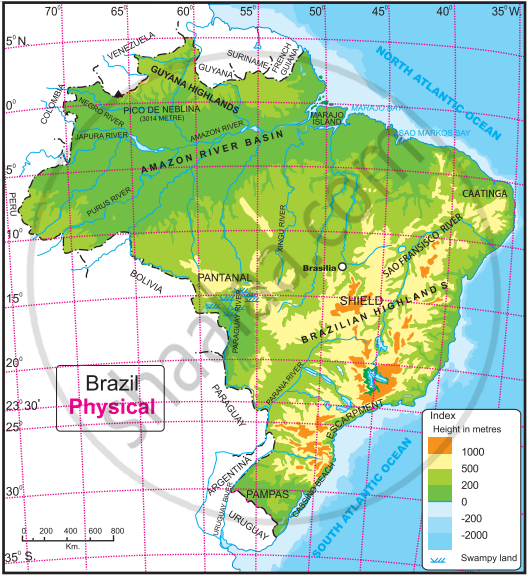
Compare the indices of both the maps.
- In which parts do the areas with highest altitude lie in both the countries, respectively?
- In which country is the range of altitude higher?
- Compare the highest range of altitudes given in both the countries. What difference do you see?
- In which direction is the slope of the Amazon river basin region?
- In which direction is the slope of the Deccan Plateau of India?
- Tell the regions of rain shadow in both the countries.
- Considering the distribution of altitude, direction of slope of land and other characteristics of physiography, write 10 sentences each about the physiography of India and Brazil.
Very Long Answer
Advertisements
Solution
- The areas with the highest altitude lie in the northern parts of India and the southeast parts of Brazil.
- The range of altitude is higher in India.
- The highest altitude range is more than 8000 meters in India and more than 1000 meters in Brazil. It shows that the range of altitude is lower in Brazil and higher in India.
- The slope of the Amazon River basin region is towards the east.
- The slope of the Deccan Plateau of India is from the western to the eastern direction.
- The rain shadow in India lies to the east of the Western Ghats and west of the Aravalli and Delhi ranges. The rain shadow in Brazil is located northeast of the Great Escarpment.
-
- Physiography of India
- India has five major physiographic divisions.
- The high Himalayas border the far north.
- Northern mountain peaks exceed 8,000 meters.
- The mountains slope steeply toward the south.
- Flat North Indian Plains lie below them.
- These fertile plains slope toward the east.
- The Peninsular Plateau occupies central India.
- The Deccan Plateau slopes west to east.
- Continuous Western Ghats border the west coast.
- Low, broken Eastern Ghats border the east.
- Physiography of Brazil
- Brazil lacks ultra-high mountain chains.
- The country features vast plains and highlands.
- The Amazon Basin forms the northern lowlands.
- Amazon plains sit below 200 meters.
- This northern basin slopes west to east.
- The Guyana Highlands border the extreme north.
- Pico de Neblina stands as the highest peak.
- Vast Brazilian Highlands dominate the south-east.
- These southern highlands slope toward the north.
- The steep Great Escarpment faces the ocean.
- Physiography of India
shaalaa.com
Is there an error in this question or solution?
