Advertisements
Advertisements
Question
Figure shows a charge array known as an electric quadrupole. For a point on the axis of the quadrupole, obtain the dependence of potential on r for r/a >> 1, and contrast your results with that due to an electric dipole, and an electric monopole (i.e., a single charge).

Advertisements
Solution
Four charges of same magnitude are placed at points X, Y, Y, and Z respectively, as shown in the following figure.

A point is located at P, which is r distance away from point Y.
The system of charges forms an electric quadrupole.
It can be considered that the system of the electric quadrupole has three charges.
Charge +q placed at point X
Charge −2q placed at point Y
Charge +q placed at point Z
XY = YZ = a
YP = r
PX = r + a
PZ = r − a
Electrostatic potential caused by the system of three charges at point P is given by,
`"V" = 1/(4piin_0)["q"/("XP") - (2"q")/("YP") + "q"/("ZP")]`
= `1/(4piin_0)["q"/("r" + "a") - (2"q")/"r" + "q"/("r" - "a")]`
= `"q"/(4piin_0)[("r"("r" - "a") - 2("r" + "a"("r" - "a") + "r"("r" + "a")))/("r"("r" + "a")("r" - "a"))]`
= `"q"/(4piin_0)[("r"^2 - "ra" - 2"r"^2 + 2"a"^2 + "r"^2 + "ra")/("r"("r"^2 - "a"^2))] = "q"/(4piin_0)[(2"a"^2)/("r"("r"^2 - "a"^2))]`
= `(2"qa"^2)/(4piin_0"r"^3(1 - "a"^2/"r"^2))`
Since `"r"/"a"` >> 1,
∴ `"a"/"r" ` << 1
`"a"^2/"r"^2` is taken as negligible.
∴ `"V" = (2"qa"^2)/(4piin_0"r"^3)`
It can be inferred that potential, `"V" prop 1/"r"^3`
However, it is known that for a dipole, `"V" prop 1/"r"^2`
And, for a monopole, `"V" prop 1/"r"`
APPEARS IN
RELATED QUESTIONS
A charge of 8 mC is located at the origin. Calculate the work done in taking a small charge of −2 × 10⁻⁹ C from a point P (0, 0, 3 cm) to a point Q (0, 4 cm, 0), via a point R (0, 6 cm, 9 cm).
Work done by a uniform electric field 'E' in moving a charge 'q' at a distance 'd' from a to b is ______.
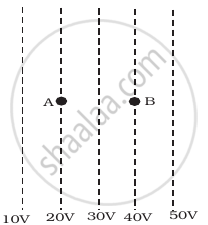
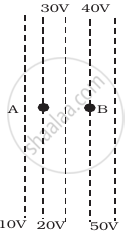
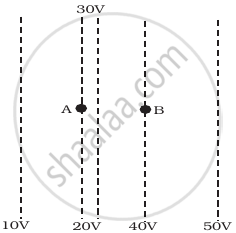
Figure shows some equipotential lines distributed in space. A charged object is moved from point A to point B.
 |
 |
 |
| (i) | (ii) | (iii) |
Depict the orientation of an electric dipole in (a) stable and (b) unstable equilibrium in an external uniform electric field. Write the potential energy of the dipole in each case.
What is the net force acting on an electric dipole when it is placed in a uniform electric field?
What is the formula for torque acting on a dipole making an angle θ with a uniform electric field?
In vector form, how is the torque on a dipole expressed in terms of dipole moment and electric field?
What must an external agent do to rotate a dipole slowly in a uniform electric field?
What reference angle is chosen to simplify the potential energy formula for a dipole, and why?
What is the final formula for the potential energy of a dipole in a uniform electric field?
What is the relationship between the torque direction and the direction of dipole rotation?
How does the potential energy of a dipole change as it rotates from being antiparallel (θ = 180°) to being parallel (θ = 0°) with the electric field?
If the electric field strength is doubled while keeping the dipole orientation constant, how does the potential energy change?
