Advertisements
Advertisements
Question
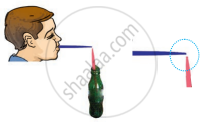
Figure shows a child blowing air with a straw near the opening of another straw which has its other end in a soft drink bottle. It was observed that the level of the soft drink in the straw rises up as soon as air is blown over its open end. Which one of the following best explains the reason for rise in level of the drink?
Options
Blowing of air decreases pressure over the opening of the straw.
The straw of the soft drink bottle collapses when air is blown over its open end.
Blowing of air warms up the air inside the straw.
Blowing of air increases the pressure on the surface of the soft drink in the bottle.
Advertisements
Solution
Blowing of air decreases pressure over the opening of the straw.
Explanation:
When air is blown over the opening of the straw, the pressure above the liquid in the straw decreases. This creates a lower pressure at the top of the straw and the higher atmospheric pressure acting on the surface of the drink inside the bottle pushes the drink up into the straw to balance the pressure difference. This causes the level of the soft drink to rise in the straw.
APPEARS IN
RELATED QUESTIONS
Explain why holes are made in hanging banners and hoardings.
The atmospheric pressure on earth surface is nearly .............. .
We do not feel uneasy even under the enormous atmospheric pressure. Give a reason.
What physical quantity is measured in torr? How is it related to the S.I. unit of the quantity?
Describe an experiment to demonstrate that air exerts pressure.
How will you show that there is vacuum above the surface of mercury in a barometer? What name is given to this vacuum?
Why do not we feel uneasy even under enormous pressure of the atmosphere above as?
On the earth, air pressure is ______
What is meant by atmospheric pressure?
Define High pressure
