Advertisements
Advertisements
Question
Explain why The climate of a harbour town is more temperate than that of a town in a desert at the same latitude.
Advertisements
Solution 1
A harbour town has a more temperate climate (i.e., without the extremes of heat or cold) than a town located in a desert at the same latitude. This is because the relative humidity in a harbour town is more than it is in a desert town.
Solution 2
The climate of a harbour town is more temperate (neither too hot nor too cool) due to formation of sea breeze at day time and land breeze at night time
APPEARS IN
RELATED QUESTIONS
Give an example of some familiar process in which heat is added to an object, without changing its temperature.
Answer in brief.
Why should a Carnot cycle have two isothermal two adiabatic processes?
Heating a gas in a constant volume container is an example of which process?
Differentiate between the reversible and irreversible processes.
3 mole of a gas at temperature 400 K expands isothermally from an initial volume of 4 litres to a final volume of 8 litres. Find the work done by the gas. (R = 8.31 J mol-1 K-1)
Explain graphically (i) positive work with varying pressure, (ii) negative work with varying pressure, and (iii) positive work at constant pressure.
Explain thermodynamics of the adiabatic process.
In an isochoric process, we have ____________.
Apply first law for an adiabatic process.
Apply first law for an isobaric process.
Explain in detail the isothermal process.
Derive the work done in an isothermal process.
What are the limitations of the first law of thermodynamics?
In an adiabatic expansion of the air, the volume is increased by 4%, what is the percentage change in pressure? (For air γ = 1.4)
A monoatomic gas of pressure p having volume V expands isothermally to a volume 2V and then adiabatically to a volume 16V. The final pressure of the gas is ____________.
`("ratio of specific heats" = 5/3)`
Ideal gas for which 'ϒ' = 1.5 is suddenly compressed to `1/4`th of its initial volume. The ratio of 4 the final pressure to the initial pressure is ______.
`(ϒ = "C"_"p"/"C"_"v")`
Consider P-V diagram for an ideal gas shown in figure.
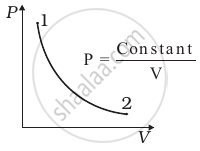
Out of the following diagrams (figure), which represents the T-P diagram?
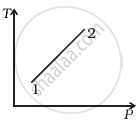 (i) |
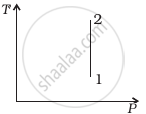 (ii) |
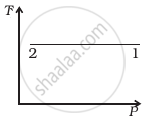 (iii) |
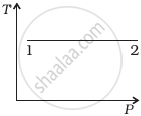 (iv) |
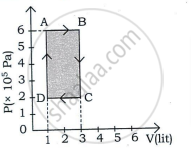
An ideal gas is taken through a cyclic process ABCDA as shown in figure. The net work done by the gas during the cycle is ______.