Advertisements
Advertisements
Question
Explain the semi-conservative replication of eukaryotic DNA.
Advertisements
Solution
Semi-conservative method of replication:
- After replication, each daughter DNA molecule has one old and other new strands.
- As parental DNA is partly conserved in each daughter's DNA, the process of replication is called semiconservative.
- The model of semiconservative replication was proposed by Watson and Crick.
Mechanism of DNA replication:
- Activation of nucleotides: All four types of DNA nucleotides are found in the nucleoplasm in the form of their monophosphates namely dAMP, dGMP, dTMP and dCMP. They are activated using ATP to form triphosphates, namely dATP, dGTP, dTTP and dCTP respectively. It occurs in the presence of the enzyme phosphorylase, and the process is called activation of nucleotides.
- Origin (Initiation): The replication starts at a specific point on the DNA molecule called the origin or initiation point. In prokaryotes, DNA has a single origin point, while in eukaryotes, there are several origin points.
- Incision: At the origin, the DNA molecule breaks because of the formation of an incision (nick). This incision is made by the activity of the endonuclease enzyme, hence hydrogen bonds get broken.
- Unwinding of the DNA molecule: The two strands start unwinding. This takes place with the help of DNA unwinding protein, i.e. helicase enzyme. By the action of topoisomerase, two strands get separated from each other. Now, the DNA molecule appears as an inverted ‘Y’ shaped structure called a replication fork. The portion or unit of DNA undergoing replication is called a replicon. The two separated strands of the DNA are stabilized by Single Strand Binding Protein (SSBP) or helix destabilizing protein.
- Synthesis of new strand: For the synthesis of a complementary new strand, each separated strand acts as a template (site) or mould. It is initiated by a small RNA molecule called RNA primer. Synthesis of this RNA primer is controlled by the enzyme RNA primase. The RNA primer attaches itself at the 3’ end of the template strand and attracts the new nucleotides from the nucleoplasm. Appropriate nucleotides are selected and are attached by H-bond to their respective complementary bases on the old strand. Synthesis of a new strand occurs in the presence of the enzyme DNA Polymerase. The successive nucleotides are joined to each other with the help of phosphodiester linkages forming a new strand.
- Leading and Lagging strand: During DNA replication, the strand which opens from 3’ to 5’ is called the leading template and its complementary strand is called the leading strand or continuous strand. It is constructed continuously at a faster rate. The other strand, which opens from 5’ to 3’, is called the lagging template, and its complementary strand is called the lagging strand. It is constructed discontinuously at a slower rate. The lagging strand is constructed in the form of short segments called Okazaki fragments which are later joined by the enzyme DNA ligase. The replication of DNA strands always takes place in the 3' to 5' direction of the template strand, while the construction of a new strand occurs in the 5’ to 3’ direction, as DNA polymerase shows 5' to 3' direction activity.
- Formation of new DNA chains: In this way for each old strand, a new complementary strand is constructed. Now, one old strand and the other new strand undergo coiling to form two identical daughter DNA molecules at the end of the process.

APPEARS IN
RELATED QUESTIONS
Which enzyme does remove supercoils from replicating DNA?
Which of the following statements is not true about DNA replication in eukaryotes?
a) Identify the figure given below
b) Redraw the structure as a replicating fork and label the parts
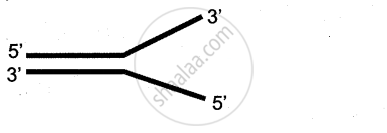
c) Write the source of energy for this replication and name the enzyme involved in this process.
d) Mention the differences in the synthesis of protein, based on the polarity of the two template strands.
During DNA replication, Okazaki fragments are used to elongate ____________.
Complementary strands of DNA molecule are (i) and bound by (ii).
E. coli, in which both the strands of DNA are labeled with 15N is transferred to 14N medium and allowed to replicate for three generations. What would be the number of hybrid DNA molecules in the third generation?
Assertion (A): DNA replication is said to be semi-conservative.
Reason (R): After DNA replication, each daughter molecule has one old and one new strand.
Which of the following is present at the sticky ends of a fragmented DNA molecule?
Which experiment provided definitive proof that DNA replication is semi-conservative?
What is the primary reason DNA replication must be highly accurate during the S-phase?
