Explain the Following : the North End of a Freely Suspended Magnetic Needle Gets Attracted Towards a Piece of Soft Iron Placed a Little Distance Away from the Needle.
Advertisements
Question
Explain the following :
The north end of a freely suspended magnetic needle gets attracted towards a piece of soft iron placed a little distance away from the needle.
Advertisements
Solution
When a piece of soft iron is placed a little distance away from the needle, the needle induces magnetism to the piece of soft iron. Thus, soft iron piece starts behaving like a magnet and it attracts the magnetic needle towards it.
APPEARS IN
RELATED QUESTIONS
The magnetic field lines produced by a bar magnet:
(a) originate from the south pole and end at its north pole
(b) originate from the north pole and end at its east pole
(c) originate from the north pole and end at its south pole
(d) originate from the south pole and end at its west pole
The wire in Figure below is being moved downwards through the magnetic field so as to produce induced current.
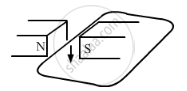
(a) moving the wire at a higher speed?
(b) moving the wire upwards rather than downwards?
(c) using a stronger magnet?
(d) holding the wire still in the magnetic field?
(e) moving the wire parallel to the magnetic field lines?
What do you understand by the term magnetic field lines?
What conclusion is drawn regarding the magnetic field at a point if a compass needle at that point rests in any direction? Give reason for your answer.
A charge of 5000 C flows through an electric circuit in 2 hours and 30 minutes. Calculate the magnitude of current in a circuit.
Select the correct option:
Nickel is a:
Draw diagram showing the arrangement of the lines of force for two magnets in line, with unlike poles facing one another.
The magnetic field is the strongest at ____________.
Can two magnetic lines of force intersect? Justify your answer:
A wire 10 cm long carrying a current of 1.5 A is held in a uniform magneÑic field in which B = 10-3 T. Calculate the force on the wire if it is held perpendicular to the lines of the magnetic field.
