Advertisements
Advertisements
Question
Explain the difference.
Degradable and non-degradable waste
Advertisements
Solution
|
Sr. No. |
Degradable waste |
Non-degradable waste |
|
(i) |
Degradable waste can be degraded or broken down into simpler, harmless substances by living organisms like microbes or microorganisms. |
Non-degradable waste cannot be degraded or broken down into simpler substances by living organisms. |
|
(ii) |
The degradation process in degradable waste is fast. |
The degradation process in non-degradable waste is slower than in biodegradable. |
|
(iii) |
Degradable waste is not collected but is used up in a short time. |
Non-degradable waste is often collected. |
|
(iv) |
Breakdown of these wastes enriches the soil such as plant and animal wastes. Therefore, such wastes are beneficial for the soil. |
They do not break down and cause soil pollution. For e.g. plastics, glass, etc. Such wastes are harmful to the soil. |
|
(v) |
Degradable waste has become part of biogeochemical cycles and gives back quick turnover. |
Most of the non-degradable waste can never enter biogeochemical cycles, is very slow and is more harmful to the earth. |
|
(vi) |
E.g., wasted food, fruits, paper, etc. |
E.g., plastic, rubber, glass, metal, etc. |
APPEARS IN
RELATED QUESTIONS
How can you help in reducing the problem of waste disposal? Give any two methods.
Students in a school listened to the news read in the morning assembly that the mountain of garbage in Delhi suddenly exploded and various vehicles got buried under it. Several people were also injured and there was traffic jam all around. In the brain storming session the teacher also discussed this issue and asked the students to find out a solution to the problem of garbage. Finally they arrived at two main points -one is self management of the garbage we produce and the second is to generate less garbage at individual level.
1) Suggest two measures to manage the garbage we produce.
2) As an individual, what can we do to generate the least garbage? Give two points.
3) List two values the teacher instilled in his student in this episode.
What is garbage?
What is known as waste?
What is meant by domestic waste?
What is biomedical waste?
How is solid waste disposed of in ah incinerator?
How does an incinerator work?
Study the image below and write down three items you have at home in each category of waste.
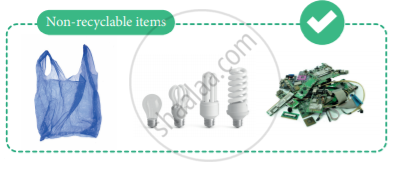
Non-recyclable: ______
In schools, waste management rules say that we should separate waste into two categories.
Write any two things that can be recycled.
______ is the very important step in waste management.
______ can return back to the soil and become food for plants.
It is best to separate waste into 3 different bins.
The burning of solid waste in ______ is called incineration.
India produces 532 million kilos of solid waste every day.
Suggest suitable mechanism(s) for waste management in fertilizer industries.
