Advertisements
Advertisements
प्रश्न
Explain the difference.
Degradable and non-degradable waste
Advertisements
उत्तर
|
Sr. No. |
Degradable waste |
Non-degradable waste |
|
(i) |
Degradable waste can be degraded or broken down into simpler, harmless substances by living organisms like microbes or microorganisms. |
Non-degradable waste cannot be degraded or broken down into simpler substances by living organisms. |
|
(ii) |
The degradation process in degradable waste is fast. |
The degradation process in non-degradable waste is slower than in biodegradable. |
|
(iii) |
Degradable waste is not collected but is used up in a short time. |
Non-degradable waste is often collected. |
|
(iv) |
Breakdown of these wastes enriches the soil such as plant and animal wastes. Therefore, such wastes are beneficial for the soil. |
They do not break down and cause soil pollution. For e.g. plastics, glass, etc. Such wastes are harmful to the soil. |
|
(v) |
Degradable waste has become part of biogeochemical cycles and gives back quick turnover. |
Most of the non-degradable waste can never enter biogeochemical cycles, is very slow and is more harmful to the earth. |
|
(vi) |
E.g., wasted food, fruits, paper, etc. |
E.g., plastic, rubber, glass, metal, etc. |
APPEARS IN
संबंधित प्रश्न
How can you help in reducing the problem of waste disposal? Give any two methods.
What can an individual do to reduce waste at home?
What are sources of waste?
Define gaseous waste.
Study the image below and write down three items you have at home in each category of waste.
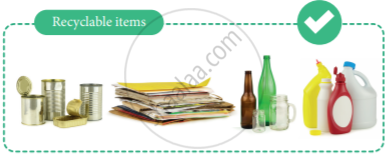
Recyclable: ______
Study the image below and write down three items you have at home in each category of waste.
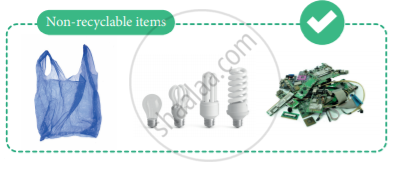
Non-recyclable: ______
In schools, waste management rules say that we should separate waste into two categories.
Explain the link between waste and dangerous diseases like dengue and malaria?
Which of the following substances will not be converted to compost when added in a composting pit?
What is transportation?
The burning of solid waste in ______ is called incineration.
The process by which waste materials are used to make new products is called recycling.
Analogy:
Biodegradable waste: Leaves, Garden wastes:: Non-biodegradable waste: ______.
What is Landfill?
What are the two major types of solid wastes?
Suggest suitable mechanism(s) for waste management in fertilizer industries.
Paheli gave the following ill effects of the practice of burning dried leaves and other plant parts
- Burning degrades the soil.
- Burning produces harmful gases/fumes.
- Precious raw materials to obtain manure at low cost is lost.
- Lot of heat is generated unnecessarily.
The correct reasons of why we should not burn leaves are
Provide a suitable term that expresses the meaning of the following statement.
An area where a lot of garbage is collected, spread out and covered with soil.
