Advertisements
Advertisements
प्रश्न
Match the items in column ‘A’ with the proper ones in column ‘B’ and explain their impact on the environment.
| Column ‘A’ | Column ‘B’ |
| 1. Harmful waste | a. Glass, rubber, carry bags, etc. |
| 2. Domestic waste | b. Chemicals, pigments, ash, etc. |
| 3. Biomedical waste | c. Radioactive material |
| 4. Industrial waste | d. Leftover food, vegetables, peelings of fruits. |
| 5. Urban waste | e. Bandages, cotton, needles, etc. |
Advertisements
उत्तर
| Column 'A' | Answers |
| 1. Harmful waste | c. Radioactive material |
| 2. Domestic waste | d. Leftover food, vegetables, peelings of fruits. |
| 3. Biomedical waste | e. Bandages, cotton, needles, etc. |
| 4. Industrial waste | b. Chemicals, pigments, ash, etc. |
| 5. Urban waste | a. Glass, rubber, carry bags, etc. |
Impact on the environment is explained as follows:
- Harmful waste - It is dangerous to the environment or human health. It is considered toxic because it is harmful to human health when a person is exposed to substances through inhalation, ingestion or touch.
- Domestic waste - It is the waste generated by the daily usage of domestic materials. Uncollected domestic waste causes health hazard as well as pollutes the environment and endanger the life of people at large.
- Biomedical waste - It is a kind of infectious material waste which is obtained especially from hospitals and causes infectious diseases.
- Industrial waste - It is produced by the industrial processes during the manufacturing of several things. This waste can be liquid, solid or gaseous, it pollutes air, soil, and nearby water sources. Water discharged from factories pollutes rivers and lakes. Dumping of industrial waste into the river causes water pollution.
- Urban waste - This waste leads to serious health and environmental issues if not disposed of or managed properly.
APPEARS IN
संबंधित प्रश्न
Explain briefly how as a student, you can help in the reduction of waste generation.
Every household produces a lot of material A daily. In one of the methods of disposal B, material A is burned at a very high temperature of about 1000°C in a structure called C. During this process, the organic matter present is removed as D and E whereas F is left behind (which can be dumped in a landfill site).
(a) What is material A?
(b) Name the method of disposal B.
(c) What is structure C known as?
(d) What are (i) D (ii) E, and (iii) F?
(e) This method is especially suitable for the disposal of materials produced by certain institutions. Name such institutions.
What can an individual do to reduce waste at home?
What do you mean by a scrubber?
Study the image below and write down three items you have at home in each category of waste.
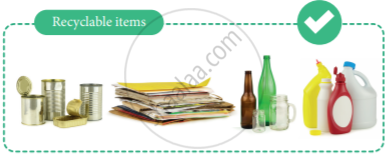
Recyclable: ______
Study the image below and write down three items you have at home in each category of waste.
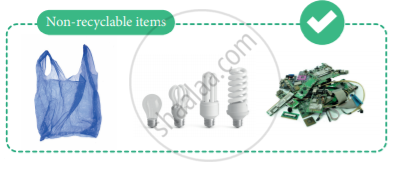
Non-recyclable: ______
In schools, waste management rules say that we should separate waste into two categories.
Explain the link between waste and dangerous diseases like dengue and malaria?
What are the sources of solid wastes? How are solid wastes managed?
______ can return back to the soil and become food for plants.
It is best to separate waste into 3 different bins.
What is transportation?
What is compost?
Garbage buried inside landfills remain here for a long time as they decompose very slowly and become _______.
The process by which waste materials are used to make new products is called recycling.
India produces 532 million kilos of solid waste every day.
Suggest suitable mechanism(s) for waste management in fertilizer industries.
Provide a suitable term that expresses the meaning of the following statement.
Contents of the waste bins.
