Advertisements
Advertisements
Question
Explain in brief the experimental proof which led to the discovery of –
Electrons
Advertisements
Solution
Electrons: English physicist William Crookes in 1878 discovered the cathode rays
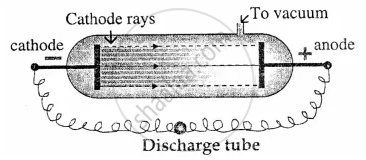
He found that when an electric discharge is passed through a tube containing a gas at low pressure (0.01 mm of Hg).
Blue rays were emitted from the negative plate [i.e. cathode]. These rays were called cathode rays and consist of negatively charged particles now called electrons. Electrons are an essential part of each and every atom.
APPEARS IN
RELATED QUESTIONS
Name the subatomic particle whose relative charge is : –1
All the gases from cathode rays and anode rays when electricity is passed through them :What does the formation of cathode rays tell us about the atoms?
How does an electron differ from a neutron?
Name the sub-atomic particle whose charge is -1.
Write down the electronic configuration of the following:
(a) `""_13^27"Y"`
(b) `""_17^35"Y"`
What are inert elements?
The electronic configuration of fluoride ion is the same as that of the neon atom. What is the difference between the two?
Choose the correct option:
The mass number of an atom whose unipositive ion has 10 electrons and 12 neutrons is :
Atoms of all metals will have ______ electrons in their outermost orbit.
When an atom gains an electron it has more electrons and thus it carries a positive charge.
