Advertisements
Advertisements
प्रश्न
Explain in brief the experimental proof which led to the discovery of –
Electrons
Advertisements
उत्तर
Electrons: English physicist William Crookes in 1878 discovered the cathode rays
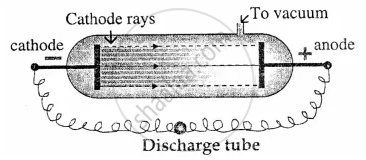
He found that when an electric discharge is passed through a tube containing a gas at low pressure (0.01 mm of Hg).
Blue rays were emitted from the negative plate [i.e. cathode]. These rays were called cathode rays and consist of negatively charged particles now called electrons. Electrons are an essential part of each and every atom.
APPEARS IN
संबंधित प्रश्न
Fill in the blank of the following statement :
Cathode rays are a beam of fast moving _________.
What are cathode rays? How are these rays formed?
Write down the number of electrons in X and neutrons in Y.
An atom X has three electrons more than the noble gas configuration. What type of ion will it form?
In the formation of (i) oxygen molecule (ii) carbon tetrachloride molecule, state the following:
- Electronic configuration of nearest inert gas attained.
- How many electrons are shared/transferred in bond formation
- Which type of bonds these compounds form?
- Draw their orbital diagrams.
Write down the electronic configuration of the following
- 2713X,
- 3517Y.
Write down the number of electrons in X and neutrons in Y and the formula of the compound formed by X and Y.[XY3]
Give a reason why noble gases have a stable electronic configuration.
_______ is a negatively charged particle.
An atom has a number of orbits and each orbit has protons.
Helium has two electrons in the outermost orbit and so it is chemically inert.
