Advertisements
Advertisements
Question
Write a short essay (250-300 words) on the following:
Examine any two sources presented in the chapter, choosing one visual and one text, and discuss how these represent the point of view of the victor and the vanquished.
Advertisements
Solution
Ordinary people join the mutiny of 1857. Lucknow was one of the main centres. The sepoys of Awadh were joined by peasants, zamindars, traders and talukdars.
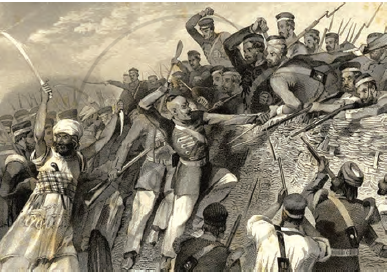
Source Sisten and the tahsildar: In the context of the communication of the message of revolt and mutiny, the experience of Francois Sisten, a native Christian police inspector in Sitapur, is telling. He had gone to Saharanpur to pay his respects to the magistrate. Sisten was dressed in Indian clothes and sitting cross-legged. A Muslim tahsildar from Bijnor entered the room; upon learning that Sisten was from Awadh, he enquired, “What news from Awadh? How does the work progress, brother?” Playing safe, Sisten replied, “If we have work in Awadh, your highness will know it.” The tahsildar said, “Depend upon it, we will succeed this time. The direction of the business is in able hands.” The tahsildar was later identified as the principal rebel leader of Bijnor. This source indicate that the effect of the rebellions had spread even among those officers who had earlier supported the British. The English men worried about their lives, property, owner of women and children. The geographical extent of the revolt was much greater. The magistrate used to get news and daily development day to day through their governmental representatives but they were suspicious as later on magistrate of Sitapur came to know that the Sisten who came to him was a great sympathiser of the rebellions.
APPEARS IN
RELATED QUESTIONS
Answer in 100-150 Words
Why Did the Mutinous Sepoys in Many Places Turn to Erstwhile Rulers to Provide Leadership to the Revolt?
Answer in 100-150 Words
Discuss the Extent to Which Religious Beliefs Shaped the Events of 1857.
Who led the revolt in Bihar?
Who was also called as ‘Danka Shah’?
Which of the following was not one of the rumours and prophecies during the 19 century?
Who among the following mobilised the villages of Pargana Barout in Uttar Pradesh in the Revolt of 1857?
Match the following.
| (i) | Rani Lakshmi Bai | (a) | Kanpur |
| (ii) | Nana Sahib | (b) | Singhbhum |
| (iii) | Kunwar Singh | (c) | Jhansi |
| (iv) | Gonoo | (d) | Arrah |
Choose the correct option.
Birjis Qadr was the younger son of ______.
Which of these was the reason for Nana Saheb’s joining the revolt of 1857?
Consider the following statements:
- Rumours played a great role in the revolt of 1857 A.D.
- Peshwa Baji Rao II adopted Nana Saheb as his son.
- The British had no answer to the action of the rebels during the months of May and June in 1857 A.D.
- Awadh was a major centre of revolt in 1857 A.D.
Read the following excerpt carefully and answer the question :
Rumours and prophecies played a part in moving people to action. The Sepoys who had arrived in Delhi from Meerut had told Bahadur Shah about the bullets coated with the fat of cow and pigs and that biting those bullets would corrupt their caste and religion. They were referring to the cartridges of the Enfield Rifles that had just been given to them. The British tried to explain to the Sepoys that this was not the case but the rumour of greased cartridge spread like wildfire across the Sepoy lines of North India.
Why did the Sepoys march to Delhi from Meerut?
Read the following excerpt carefully and answer the question :
Rumours and prophecies played a part in moving people to action. The Sepoys who had arrived in Delhi from Meerut had told Bahadur Shah about the bullets coated with the fat of cow and pigs and that biting those bullets would corrupt their caste and religion. They were referring to the cartridges of the Enfield Rifles that had just been given to them. The British tried to explain to the Sepoys that this was not the case but the rumour of greased cartridge spread like wildfire across the Sepoy lines of North India.
How did the rumour of greased cartridges spread like wildfire across the cantonments?
Read the following excerpt carefully and answer the question :
Rumours and prophecies played a part in moving people to action. The Sepoys who had arrived in Delhi from Meerut had told Bahadur Shah about the bullets coated with the fat of cow and pigs and that biting those bullets would corrupt their caste and religion. They were referring to the cartridges of the Enfield Rifles that had just been given to them. The British tried to explain to the Sepoys that this was not the case but the rumour of greased cartridge spread like wildfire across the Sepoy lines of North India.
Choose the correct option.
Assertion(A): According to the rumour the cartridges were greased with the fat of cows and pigs.
Reason(R): The Sepoys refused to use these cartridges because for Hindu Sepoys, the cow was a revered animal and for the Muslims, the pig was a hated animal.
On the same outline map of India, a place related to the centres of the Revolt of 1857 is marked as A. Identify it and write its name on the line drawn near them.
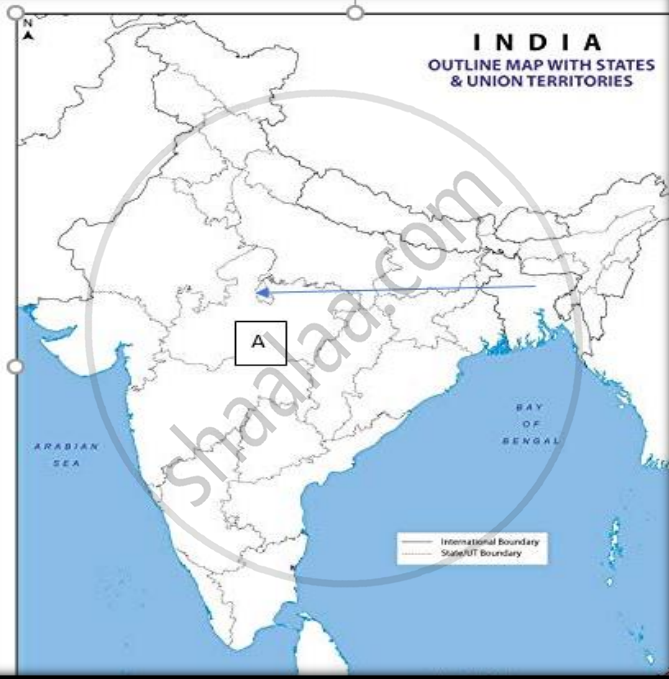
From where did the revolt of 1857 start?
Consider the following events:
- Abolition of sati.
- Passing of Widow Remarriage Act.
- The beginning of the revolt.
- Queen's Proclamation.
The correct chronological order of these events is:
Consider the following statements regarding the revolt of 1857:
- Late in the afternoon of 10 May 1857, the sepoys in the cantonment of Meerut broke out in mutiny which began in the lines of the native infantry, spread very swiftly to the cavalry and then to the city
- The ordinary people of the town and surrounding villages joined the sepoys. The sepoys captured the bell of arms where the arms and ammunition were kept and proceeded to attack white people, and to ransack and bum their bungalows and property.
- The sepoys arrived at the gates of the Red Fort early in the morning on 11 May.
Which of the following statement(s) is/ are correct?
The tradition of Sati was abolished in the year:
Who was the prominent leader in Jagdishpur, Bihar during the Revolt of 1857?
"The Sepoys Mutiny and the rebellion of 1857" written by:
Who had started the Home Rule Movement in India?
At which place mutiny broke out on 10th May, 1857?
Nana Saheb was selected to led the Revolt of 1857 from ______.
Distribution of chapattis in villages were perceived as ______.
Which among the following is correctly matched?
| List I CENTRE | List II LEADER |
| A. Delhi | Nana Saheb |
| B. Kanpur | Kunwar Singh |
| C. Arrah | Bahadur Shah |
| D. Lucknow | Birjis Qadr |
Which of the following pairs is correctly matched?
'British, did not have an easy time in putting down the Revolt of 1857.' Explain the statement with examples.
