Advertisements
Advertisements
Question
'British, did not have an easy time in putting down the Revolt of 1857.' Explain the statement with examples.
Advertisements
Solution
- The Sepoys turning against the British led to a reduction in the size of the British army.
- Peasants and villagers in Awadh and other locations helped the sepoys and joined the insurrection, giving the impression that it was a small-scale popular movement. The uprising began in many places, including Awadh, Kanpur, Lucknow, Arrah, Jhansi, etc.
- Some resentful kingdoms saw the zamindars and kings rise up in revolt against the British.
APPEARS IN
RELATED QUESTIONS
Answer in 100-150 Words
Discuss the Extent to Which Religious Beliefs Shaped the Events of 1857.
What is a Bell of arms?
Which of the following is an incorrect match for the Centre of the revolt and their leaders?
Which of the following was the immediate cause of the Revolt of 1857?
Who among the following mobilised the villages of Pargana Barout in Uttar Pradesh in the Revolt of 1857?
Arrange the following events in chronological order:
- Introduction of Summary Revenue Settlement
- Subsidiary Alliance introduced in Awadh
- Rani Jhansi killed in the battle
- Delhi captured by the British June
Choose the correct option.
From where did the revolt of 1857 start?
Which of these was the reason for Nana Saheb’s joining the revolt of 1857?
Consider the following statements:
- Rumours played a great role in the revolt of 1857 A.D.
- Peshwa Baji Rao II adopted Nana Saheb as his son.
- The British had no answer to the action of the rebels during the months of May and June in 1857 A.D.
- Awadh was a major centre of revolt in 1857 A.D.
Read the following excerpt carefully and answer the question :
Rumours and prophecies played a part in moving people to action. The Sepoys who had arrived in Delhi from Meerut had told Bahadur Shah about the bullets coated with the fat of cow and pigs and that biting those bullets would corrupt their caste and religion. They were referring to the cartridges of the Enfield Rifles that had just been given to them. The British tried to explain to the Sepoys that this was not the case but the rumour of greased cartridge spread like wildfire across the Sepoy lines of North India.
Why did the Sepoys march to Delhi from Meerut?
Read the following excerpt carefully and answer the question :
Rumours and prophecies played a part in moving people to action. The Sepoys who had arrived in Delhi from Meerut had told Bahadur Shah about the bullets coated with the fat of cow and pigs and that biting those bullets would corrupt their caste and religion. They were referring to the cartridges of the Enfield Rifles that had just been given to them. The British tried to explain to the Sepoys that this was not the case but the rumour of greased cartridge spread like wildfire across the Sepoy lines of North India.
How did the rumour of greased cartridges spread like wildfire across the cantonments?
Read the following excerpt carefully and answer the question :
Rumours and prophecies played a part in moving people to action. The Sepoys who had arrived in Delhi from Meerut had told Bahadur Shah about the bullets coated with the fat of cow and pigs and that biting those bullets would corrupt their caste and religion. They were referring to the cartridges of the Enfield Rifles that had just been given to them. The British tried to explain to the Sepoys that this was not the case but the rumour of greased cartridge spread like wildfire across the Sepoy lines of North India.
Choose the correct option.
Assertion(A): According to the rumour the cartridges were greased with the fat of cows and pigs.
Reason(R): The Sepoys refused to use these cartridges because for Hindu Sepoys, the cow was a revered animal and for the Muslims, the pig was a hated animal.
On the same outline map of India, a place related to the centres of the Revolt of 1857 is marked as A. Identify it and write its name on the line drawn near them.
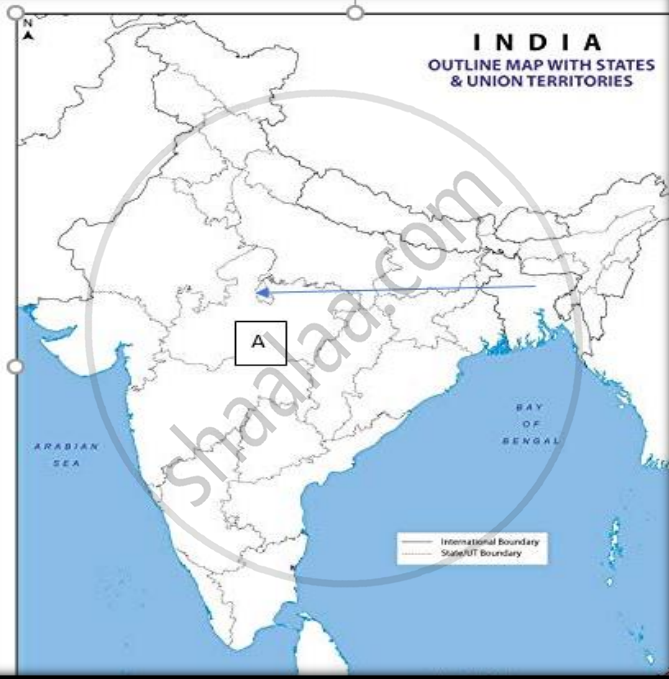
From where did the revolt of 1857 start?
Consider the following events:
- Abolition of sati.
- Passing of Widow Remarriage Act.
- The beginning of the revolt.
- Queen's Proclamation.
The correct chronological order of these events is:
Consider the following statements regarding the 1857 mutiny when reached Delhi:
- The sepoys from Meerut arrived at the gates of the Red Fort early in the morning on 11 May.
- Europeans had been protected by the rich people in Delhi.
- Once word spread that Delhi had fallen to the rebels and Bahadur Shah had blessed the rebellion, events moved swiftly.
Which of the following statement(s) is/are correct?
Who had started the Home Rule Movement in India?
At which place mutiny broke out on 10th May, 1857?
The Sepoys of Revolt 1857, arrived Delhi on ______.
Shah Mal become the leaders of Revolt 1857 of Pargana Baraut in ______.
Captain Hearsey was given protection by ______.
Match the following.
| List I | List II |
| A. Kanpur | i. Shah Mal |
| B. Pargana Barout | ii. Nana Sahib |
| C. Singhbhum | iii. Maulvi Ahmadullah |
| D. Faizabad | iv. Gonoo |
Which among the following is correctly matched?
| List I CENTRE | List II LEADER |
| A. Delhi | Nana Saheb |
| B. Kanpur | Kunwar Singh |
| C. Arrah | Bahadur Shah |
| D. Lucknow | Birjis Qadr |
Which of the following pairs is correctly matched?
Who among the following led the Flag of the Revolt 1857 against the British in Bihar?
