English

Evaluate the Following Definite Integrals as Limit of Sums. `Int_0^4 (X + E^(2x)) Dx` - Mathematics

Advertisements
Advertisements

Question

Evaluate the following definite integrals as limit of sums.

`int_0^4 (x + e^(2x)) dx`

Advertisements

Solution
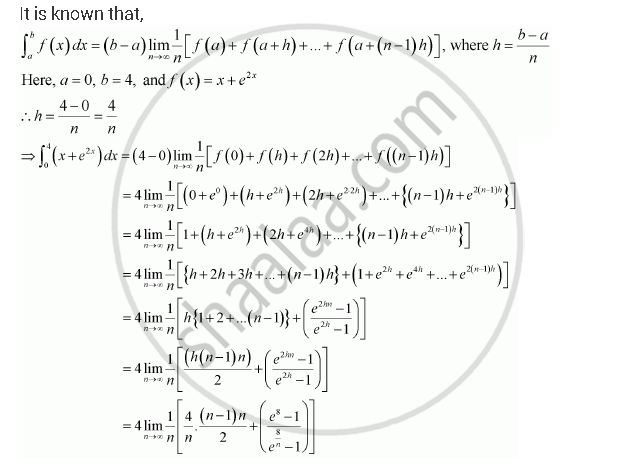
shaalaa.com
  Is there an error in this question or solution?
Chapter 7: Integrals - Exercise 7.8 [Page 334]

APPEARS IN

NCERT Mathematics Part 1 and 2 [English] Class 12
Chapter 7 Integrals
Exercise 7.8 | Q 6 | Page 334

RELATED QUESTIONS

Evaluate the definite integral:

`int_1^4 [|x - 1|+ |x - 2| + |x -3|]dx`


Prove the following:

`int_0^1 xe^x dx = 1`


Prove the following:

`int_(-1)^1 x^17 cos^4 xdx = 0`


Prove the following:

`int_0^(pi/4) 2 tan^3 xdx = 1 - log 2`


Evaluate  `int_0^1 e^(2-3x) dx` as a limit of a sum.


`int dx/(e^x + e^(-x))` is equal to ______.


If f (a + b - x) = f (x), then `int_a^b x f(x )dx` is equal to ______.


\[\int\frac{1 + \cos x}{\left( x + \sin x \right)^3} dx\]

\[\int\cot x \cdot \log \text{sin x dx}\]

\[\text{ ∫  cosec x  log}      \left( \text{cosec x} - \cot x \right) dx\]

\[\int \sec^4    \text{ x   tan x dx} \]

\[\int\limits_0^1 \left( x e^x + \cos\frac{\pi x}{4} \right) dx\]


\[\int\limits_0^\pi \frac{\sin x}{\sin x + \cos x} dx\]

\[\int\frac{\sqrt{\tan x}}{\sin x \cos x} dx\]


Using L’Hospital Rule, evaluate: `lim_(x->0)  (8^x - 4^x)/(4x
)`


Evaluate `int_1^4 ( 1+ x +e^(2x)) dx` as limit of sums.


Solve: (x2 – yx2) dy + (y2 + xy2) dx = 0 


Evaluate:

`int (sin"x"+cos"x")/(sqrt(9+16sin2"x")) "dx"`


Evaluate `int_(-1)^2 (7x - 5)"d"x` as a limit of sums


If f and g are continuous functions in [0, 1] satisfying f(x) = f(a – x) and g(x) + g(a – x) = a, then `int_0^"a" "f"(x) * "g"(x)"d"x` is equal to ______.


Evaluate the following:

`int_0^2 ("d"x)/("e"^x + "e"^-x)`


Evaluate the following:

`int_0^(pi/2) (tan x)/(1 + "m"^2 tan^2x) "d"x`


Evaluate the following:

`int_0^1 (x"d"x)/sqrt(1 + x^2)`


Evaluate the following:

`int_0^pi x sin x cos^2x "d"x`


Evaluate the following:

`int_0^(1/2) ("d"x)/((1 + x^2)sqrt(1 - x^2))`  (Hint: Let x = sin θ)


Evaluate the following:

`int_(pi/3)^(pi/2) sqrt(1 + cosx)/(1 - cos x)^(5/2)  "d"x`


The value of `lim_(x -> 0) [(d/(dx) int_0^(x^2) sec^2 xdx),(d/(dx) (x sin x))]` is equal to


If f" = C, C ≠ 0, where C is a constant, then the value of `lim_(x -> 0) (f(x) - 2f (2x) + 3f (3x))/x^2` is


Left `f(x) = {{:(1",", "if x is rational number"),(0",", "if x is irrational number"):}`. The value `fof (sqrt(3))` is


`lim_(x -> 0) (xroot(3)(z^2 - (z - x)^2))/(root(3)(8xz - 4x^2) + root(3)(8xz))^4` is equal to


Let f: (0,2)→R be defined as f(x) = `log_2(1 + tan((πx)/4))`. Then, `lim_(n→∞) 2/n(f(1/n) + f(2/n) + ... + f(1))` is equal to ______.


`lim_(n→∞){(1 + 1/n^2)^(2/n^2)(1 + 2^2/n^2)^(4/n^2)(1 + 3^2/n^2)^(6/n^2) ...(1 + n^2/n^2)^((2n)/n^2)}` is equal to ______.


`lim_(n rightarrow ∞)1/2^n [1/sqrt(1 - 1/2^n) + 1/sqrt(1 - 2/2^n) + 1/sqrt(1 - 3/2^n) + ...... + 1/sqrt(1 - (2^n - 1)/2^n)]` is equal to ______.


Share
Notifications

Englishहिंदीमराठी


      Forgot password?
Use app×