Advertisements
Advertisements
Question
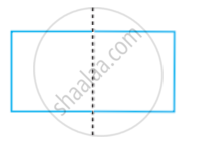
Draw the mirror image: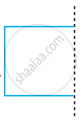
Advertisements
Solution
APPEARS IN
RELATED QUESTIONS
Take a graph paper and mark the points P(2, 1), Q(7, 1) and R(7,5). Taking QR as the line of symmetry, obtain and write the co-ordinates of point S.
A(8,2) and B(6,4) are the vertices of a figure which is symmetrical about x = 6 and y = 2. Complete the figure and give the geometrical name of the figure.
In the following figure, the line of symmetry has been drawn with a dotted line. Identify the corresponding sides and the corresponding angles about the line of symmetry.
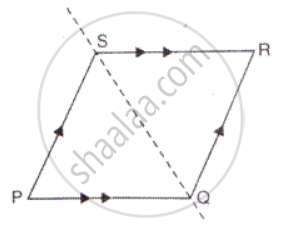
Write capital letters A to Z of English alphabet; and in each case, if possible, draw the largest number of lines of symmetry.
By drawing a freehand sketch of the following, draw the line (s) of symmetry, if any:
a kite-shaped figure triangle
Draw a triangle with exactly two lines of symmetry. In case, if possible, represent the line/ lines of symmetry by dotted lines. Also, write the special name of the triangle drawn.
In the figure given below, draw the line (s) of symmetry, if possible:
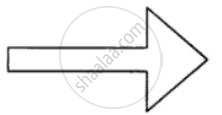
A quadrilateral ABCD is symmetric about its diagonal AC. Name three sides of this quadrilateral which are equal.
In the figure below are an isosceles triangle; state if the triangle is a symmetrical figure. If a figure is symmetrical, state the number of axis of symmetry and indicate them by dotted line.
In each of the figure below, state the number of axes of symmetry, if any.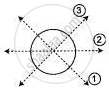
A quadrilateral ABCD has exactly one axis of symmetry, which is not a diagonal. Show that the quadrilateral is an isosoeles trapezium.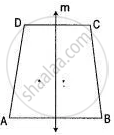
One day his clever daughter gave him an idea which he liked very much. Now he never got confused.
- Can you guess what the idea was?
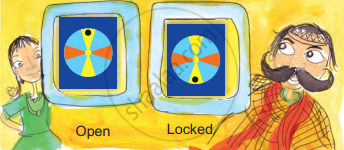
Which of these English words reads the same on half a turn?
ZOOM, MOW, SWIMS, SIS, NOON
Identify the shape given below. Check whether they are symmetric or not. Draw the line of symmetry as well.
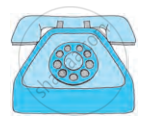
Draw all lines of symmetry for the following figure as given below:

Trace figure. Then draw all lines of symmetry, if it has.

Draw all lines of symmetry for the following figure.

The flag of Japan is shown below. How many lines of symmetry does the flag have?

Which of the following figures do not have line symmetry?
