Advertisements
Advertisements
Question
Draw the atomic diagram of the following element showing the distribution of – protons, neutrons and the electrons in the various shell of the atom.
Phosphorus – \[\ce{^31_15P}\]
[The upper number represent the – mass number and the lower number represent the – atomic number e.g. calcium – mass number = 40, atomic number = 20]
Advertisements
Solution
Phosphorus – \[\ce{^31_15P}\]
Atomic number Z = p = e = 15
Mass number A = p + n
31 = 15 + n
∴ n = 31 − 15 = 16
P
15 = 2, 8, 5
(K, L, M)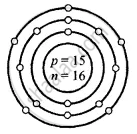
APPEARS IN
RELATED QUESTIONS
Explain the Atomic number with example.
In Milikan’s experiment, static electric charge on the oil drops has been obtained by shining X-rays. If the static electric charge on the oil drop is - 1.282 × 10⁻¹⁸C, calculate the number of electrons present on it.
Multiple Choice Questions
If the atomic number of an atom is 17 and mass number is 35 then number of neutron will be
The atom of an element is made up of 4 protons, 5 neutrons and 4 electrons. What is its atomic number and mass number?
Fill in the Blank of the Following Statement :
An atom has atomic mass number 23 and atomic number 11. The atom has .................... electrons.
From the symbol `""_15^31"P"`, state : atomic number of phosphorus
The atom of an element X has 7 electrons in its M shell.
What is the atomic number of element X?
Sulphur has an atomic number 16 and a mass of 32.
State the number of protons and neutrons in the nucleus of sulphur. Give a simple diagram to show the arrangement of electrons in an atom of sulphur.
Draw the atomic diagram of the following element showing the distribution of – protons, neutrons and the electrons in the various shell of the atom.
Argon – \[\ce{^40_18Ar}\]
[The upper number represent the – mass number and the lower number represent the – atomic number e.g. calcium – mass number = 40, atomic number = 20]
Elements A, B and C have atomic numbers 9, 20 and 10 respectively.
- State which one is
(1) a non-metal,
(2) a metal,
(3) chemically inert.[A,B,C] - Write down the formula of the compound formed by two of the above elements.[BA2]
