Advertisements
Advertisements
प्रश्न
Draw the atomic diagram of the following element showing the distribution of – protons, neutrons and the electrons in the various shell of the atom.
Phosphorus – \[\ce{^31_15P}\]
[The upper number represent the – mass number and the lower number represent the – atomic number e.g. calcium – mass number = 40, atomic number = 20]
Advertisements
उत्तर
Phosphorus – \[\ce{^31_15P}\]
Atomic number Z = p = e = 15
Mass number A = p + n
31 = 15 + n
∴ n = 31 − 15 = 16
P
15 = 2, 8, 5
(K, L, M)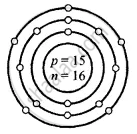
APPEARS IN
संबंधित प्रश्न
Fill in the blanks.
Isotopes are the atoms of ______ element having the ______ atomic number but ______ mass number.
FILL IN THE BLANK
Atomic theory of matter was given by ..........................
Tick the most appropriate answer.
Which of these have similar chemical properties but different set of physical properties and mass number?
- isobars
- elements
- isotopes
- none of these
Name the particles which actually determine the mass of an atom.
Elements A, B and C have atomic numbers 9, 20 and 10 respectively.
- State which one is
(1) a non-metal,
(2) a metal,
(3) chemically inert.[A,B,C] - Write down the formula of the compound formed by two of the above elements.[BA2]
An element ‘A’ has mass number 23 and atomic number 11. State the –
- no. of neutrons in its shell,
- electronic configuration of the element ‘A’.
Complete the following table.
| Atomic Number | Mass Number | Number of Neutrons | Number of Protons | Number of Electrons | Name of the Element |
| 9 | ______ | 10 | ______ | ______ | ______ |
| 16 | ______ | 16 | ______ | ______ | ______ |
| ______ | 24 | ______ | ______ | 12 | Magnesium |
| ______ | 2 | ______ | 1 | ______ | ______ |
| ______ | 1 | 0 | 1 | 1 | ______ |
Which of the following are true for an element?
- Atomic number = number of protons + number of electrons
- Mass number = number of protons + number of neutrons
- Atomic mass = number of protons = number of neutrons
- Atomic number = number of protons = number of electrons
‘A’ is denoted by ______.
If element M has mass number 24 and atomic number 12, how many neutrons does its atom contain?
