English

Draw the Ray Diagram Showing Refraction of Light Through a Glass Prism and Hence Obtain the Relation Between the Refractive Index μ of the Prism, Angle of Prism and Angle of Minimum Deviation. - Physics

Advertisements
Advertisements

Question

Draw the ray diagram showing refraction of light through a glass prism and hence obtain the relation between the refractive index μ of the prism, angle of prism and angle of minimum deviation.

Advertisements

Solution

 The figure below shows the passage of light through a triangular prism ABC.

The angles of incidence and refraction at first face AB are ∠i and ∠r1.

The angle of incidence at the second face AC is ∠r2 and the angle of emergence ∠e.

δ is the angle between the emergent ray RS and incident ray PQ and is called the angle of deviation.

Here, ∠PQN = i

SRN'=e

∠RQO = r1

∠QRO = r2

∠KTS = δ

∴ ∠TQO = i and ∠RQO = r1, we have

∠TQR = i − r1

∠TRO = e and ∠QRO = r2

∠TRQ = − r2

In triangle TQR, the side QT has been produced outwards. Therefore, the exterior angle δ should be equal to the sum of the interior opposite angles.

i.e, δ= ∠TQR + ∠TRQ = (i − r1) + (e − r2)

δ = (e) − (r1r2)   ..…(i)

In triangle QRO,

r1r2+ ∠ROQ = 180°   ..…(ii)

From quadrilateral AROQ, we have the sum of angles (∠AQO + ∠ARO = 180°). This means that the sum of the remaining two angles should be 180°.

i.e , ∠A + ∠QOR = 180° [∠A is called the angle of prism]

From equations (i) and (ii),

r1r2 = A (iii)

Substituting (iii) in (i), we obtain

δ = (i + e) − A

\[A + \delta = i + e\]
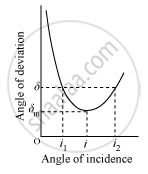
If the angle of incidence is increased gradually, then the angle of deviation first decreases, attains a minimum value (δm), and then again starts increasing.

When angle of deviation is minimum, the prism is said to be placed in the minimum deviation position.

There is only one angle of incidence for which the angle of deviation is minimum.

When

δ = δm [prism in minimum deviation position],

e = i and r2 = r1 = r …(iv)

\[\because r_1 + r_2 = A\]

From equation (iv), r + r = A

\[r = \frac{A}{2}\]

Also, we have

A + δ = i + e

Setting,

δ = δm and e = i

A + δm i + i

\[i = \frac{\left( A + \delta_m \right)}{2}\]

\[ \because \mu = \frac{\sin i}{\sin r}\]

\[ \therefore \mu = \frac{\sin\left( \frac{A + \delta_m}{2} \right)}{\sin\left( \frac{A}{2} \right)}\]


shaalaa.com
  Is there an error in this question or solution?
2016-2017 (March) Foreign Set 3

Video TutorialsVIEW ALL [2]

RELATED QUESTIONS

A ray of light passes through an equilateral glass prism such that the angle of incidence is equal to the angle of emergence and each of these angles is equal to 3/4 of angle of prism. Find the angle of deviation.


What is the cause of dispersion of light


Give the formula that can be used to determine refractive index of materials of a prism in minimum deviation condition ?


A certain material has refractive indices 1.56, 1.60 and 1.68  rfor red, yellow and violet lightespectively. (a) Calculate the dispersive power. (b) Find the angular dispersion produced by a thin prism of angle 6° made of this material.


Three thin prisms are combined as shown in figure. The refractive indices of the crown glass for red, yellow and violet rays are μr, μy and μv respectively and those for the flint glass are μ'r, μ'y and μ'v respectively. Find the ratio A'/A for which (a) there is no net angular dispersion, and (b) there is no net deviation in the yellow ray.


The deviation produced for violet, yellow and red lights for crown glass are 3.75°, 3.25° and 2.86° respectively. Calculate the dispersive power of the crown glass.


 A narrow beam of monochromatic light, PQ, is incident normally on one face of an equiangular glass prism of refractive index 1.45. When the prism is immersed in a certain liquid, the ray makes a grazing emergence along the other face (See figure). Find the refractive index of this liquid. 


 What is meant by the dispersive power of transparent material?


The refractive indices of material for red, violet and yellow colour light are 1.52, 1.62 and 1.59 respectively.
Calculate the dispersive power of the material. If the mean deviation is 40°. What will be the angular dispersion produced by a prism of this material?


What is meant by a thin prism?


Share
Notifications

Englishहिंदीमराठी


      Forgot password?
Use app×