Advertisements
Advertisements
प्रश्न
Draw the ray diagram showing refraction of light through a glass prism and hence obtain the relation between the refractive index μ of the prism, angle of prism and angle of minimum deviation.
Advertisements
उत्तर
The figure below shows the passage of light through a triangular prism ABC.

The angles of incidence and refraction at first face AB are ∠i and ∠r1.
The angle of incidence at the second face AC is ∠r2 and the angle of emergence ∠e.
δ is the angle between the emergent ray RS and incident ray PQ and is called the angle of deviation.
Here, ∠PQN = i
∠SRN'=e
∠RQO = r1
∠QRO = r2
∠KTS = δ
∴ ∠TQO = i and ∠RQO = r1, we have
∠TQR = i − r1
∠TRO = e and ∠QRO = r2
∠TRQ = e − r2
In triangle TQR, the side QT has been produced outwards. Therefore, the exterior angle δ should be equal to the sum of the interior opposite angles.
i.e, δ= ∠TQR + ∠TRQ = (i − r1) + (e − r2)
δ = (i + e) − (r1+ r2) ..…(i)
In triangle QRO,
r1+ r2+ ∠ROQ = 180° ..…(ii)
From quadrilateral AROQ, we have the sum of angles (∠AQO + ∠ARO = 180°). This means that the sum of the remaining two angles should be 180°.
i.e , ∠A + ∠QOR = 180° [∠A is called the angle of prism]
From equations (i) and (ii),
r1+ r2 = A (iii)
Substituting (iii) in (i), we obtain
δ = (i + e) − A
\[A + \delta = i + e\]
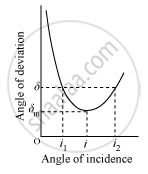
If the angle of incidence is increased gradually, then the angle of deviation first decreases, attains a minimum value (δm), and then again starts increasing.
When angle of deviation is minimum, the prism is said to be placed in the minimum deviation position.
There is only one angle of incidence for which the angle of deviation is minimum.
When
δ = δm [prism in minimum deviation position],
e = i and r2 = r1 = r …(iv)
\[\because r_1 + r_2 = A\]
From equation (iv), r + r = A
\[r = \frac{A}{2}\]
Also, we have
A + δ = i + e
Setting,
δ = δm and e = i
A + δm = i + i
\[i = \frac{\left( A + \delta_m \right)}{2}\]
\[ \because \mu = \frac{\sin i}{\sin r}\]
\[ \therefore \mu = \frac{\sin\left( \frac{A + \delta_m}{2} \right)}{\sin\left( \frac{A}{2} \right)}\]
APPEARS IN
संबंधित प्रश्न
A ray of light passes through an equilateral glass prism such that the angle of incidence is equal to the angle of emergence and each of these angles is equal to 3/4 of angle of prism. Find the angle of deviation.
Two monochromatic rays of light are incident normally on the face AB of an isosceles right-angled prism ABC. The refractive indices of the glass prism for the two rays '1' and '2' are respectively 1.38 and 1.52. Trace the path of these rays after entering through the prism.

What is the cause of dispersion of light
A ray of light incident normally on one face of a right isosceles prism is totally reflected, as shown in fig. What must be the minimum value of refractive index of glass? Give relevant calculations.

The equation \[\omega = \frac{\mu_u - \mu_r}{\mu - 1}\] was derived for a prism having small refracting angle. Is it also valid for a prism of large refracting angle? Is it also valid for a glass slab or a glass sphere?
The angular dispersion produced by a prism ___________ .
A thin prism of angle 6.0°, ω = 0.07 and μy = 1.50 is combined with another thin prism having ω = 0.08 and μy = 1.60. The combination produces no deviation in the mean ray. (a) Find the angle of the second prism. (b) Find the net angular dispersion produced by the combination when a beam of white light passes through it. (c) If the prisms are similarly directed, what will be the deviation in the mean ray? (d) Find the angular dispersion in the situation described in (c).
The refractive index of a material M1 changes by 0.014 and that of another material M2 changes by 0.024 as the colour of the light is changed from red to violet. Two thin prisms, one made of M1(A = 5.3°) and the other made of M2(A = 3.7°) are combined with their refracting angles oppositely directed. (a) Find the angular dispersion produced by the combination. (b) The prisms are now combined with their refracting angles similarly directed. Find the angular dispersion produced by the combination.
Calculate dispersive power of a transparent material given : nv = 1.56, nr = 1.54, ny = 1.55.
A narrow beam of monochromatic light, PQ, is incident normally on one face of an equiangular glass prism of refractive index 1.45. When the prism is immersed in a certain liquid, the ray makes a grazing emergence along the other face (See figure). Find the refractive index of this liquid. 
