Advertisements
Advertisements
Question
Draw a neat labeled diagram of an A.C. generator
Advertisements
Solution 1

Solution 2
The figure below shows the variation in induced e.m.f. relative to various positions of coil, during its one complete rotation. The e.m.f. is maximum when the coil is with its plane parallel to the magnetic field.
Diagram of A.C. generator

APPEARS IN
RELATED QUESTIONS
A coil of insulated copper wire is connected to a galvanometer. What will happen if a bar magnet is pushed into the coil?
Explain the underlying principle and working of an electric generator by drawing a labelled diagram. What is the function of brushes?
What change should be made in an a.c. generator so that it may become a d.c. generator?
Explain the difference:
AC generator and DC generator.
The given figures 1 to 3 show the working of a simple A.C. generator. Study the diagrams and answers of the following questions.
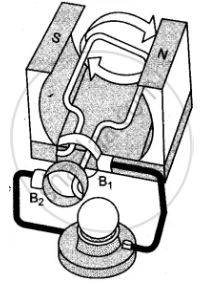
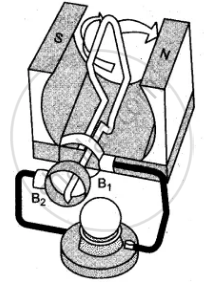
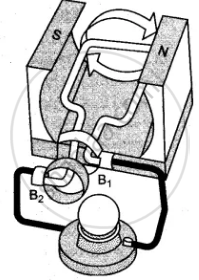
(i) State and explain the principle underlying the working of a simple generator.
(ii) Where is the loop of wire placed?
(iii) What happens when the loop is rotated?
(iv) Indicate the direction of the current flow through the wire for the first half of the turn (in first figure). Name and state the rule used in finding the direction of the current.
(v) Indicate the direction of the current for the case shown in second figure.
(vi) Indicate the direction of current in the outer circuit (i.e., electric bulb) in first and third figure.
(vii) What type of current is shown in the above diagrams? Explain.
What energy conversion takes place in an a.c. generator?
Which are listed as sources of mechanical energy supplied to the rotor shaft?
When is the magnetic flux maximum if the coil starts perpendicular to \[B\]?
How is a generator driven in a hydroelectric plant?
Which energy source and sequence describe generator use in a nuclear power plant?
