English

Draw a Labelled Ray Diagram Showing the Formation of a Final Image by a Compound Microscope at Least Distance of Distinct Vision - Physics

Advertisements
Advertisements

Questions

Draw a labelled ray diagram showing the formation of a final image by a compound microscope at least distance of distinct vision

Draw a ray diagram for the formation of image by a compound microscope

Advertisements

Solution 1
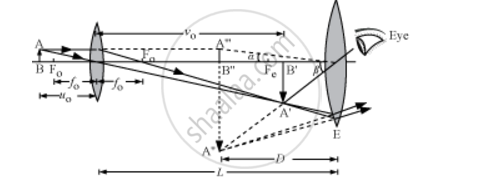
where, AB = object, A'B' = image formed by objective and A''B'' = image formed by eyepiece

fo = focal length of objective,

uo = object distance from objective

vo = image distance from objective

D = distance of least distinct vision

L = length of the microscope

shaalaa.com

Solution 2
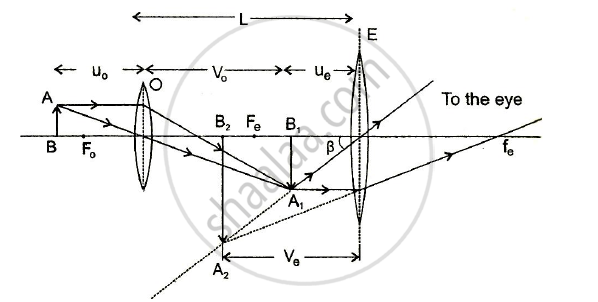
shaalaa.com
  Is there an error in this question or solution?
2013-2014 (March) Delhi Set 1

RELATED QUESTIONS

When viewing through a compound microscope, our eyes should be positioned not on the eyepiece but a short distance away from it for best viewing. Why? How much should be that short distance between the eye and eyepiece?


Draw a ray diagram to show the working of a compound microscope. Deduce an expression for the total magnification when the final image is formed at the near point.

In a compound microscope, an object is placed at a distance of 1.5 cm from the objective of focal length 1.25 cm. If the eye piece has a focal length of 5 cm and the final image is formed at the near point, estimate the magnifying power of the microscope.


Can the image formed by a simple microscope be projected on a screen without using any additional lens or mirror?


The separation between the objective and the eyepiece of a compound microscope can be adjusted between 9.8 cm to 11.8 cm. If the focal lengths of the objective and the eyepiece are 1.0 cm and 6 cm respectively, find the range of the magnifying power if the image is always needed at 24 cm from the eye


Define the magnifying power of a microscope in terms of visual angle.


What is the advantage of a compound microscope over a simple microscope?


How does the resolving power of a microscope change when
(i) the diameter of the objective lens is decreased?
(ii) the wavelength of the incident light is increased ?
Justify your answer in each case.


A thin converging lens of focal length 5cm is used as a simple microscope. Calculate its magnifying power when image formed lies at:

  1. Infinity.
  2. Least distance of distinct vision (D = 25 cm).

In a compound microscope an object is placed at a distance of 1.5 cm from the objective of focal length 1.25 cm. If the eye-piece has a focal length of 5 cm and the final image is formed at the near point, find the magnifying power of the microscope.


What is meant by a microscope in normal use?


Share
Notifications

Englishहिंदीमराठी


      Forgot password?
Use app×