मराठी

Draw a Labelled Ray Diagram Showing the Formation of a Final Image by a Compound Microscope at Least Distance of Distinct Vision - Physics

Advertisements
Advertisements

प्रश्न

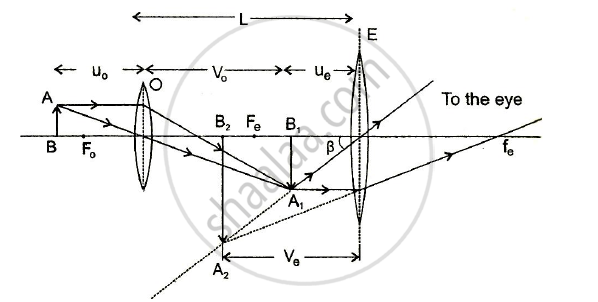
Draw a labelled ray diagram showing the formation of a final image by a compound microscope at least distance of distinct vision

Draw a ray diagram for the formation of image by a compound microscope

Advertisements

उत्तर १
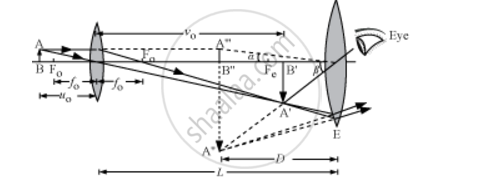
where, AB = object, A'B' = image formed by objective and A''B'' = image formed by eyepiece

fo = focal length of objective,

uo = object distance from objective

vo = image distance from objective

D = distance of least distinct vision

L = length of the microscope

shaalaa.com

उत्तर २
shaalaa.com
  या प्रश्नात किंवा उत्तरात काही त्रुटी आहे का?
2013-2014 (March) Delhi Set 1

व्हिडिओ ट्यूटोरियलVIEW ALL [2]

संबंधित प्रश्‍न

You are given the following three lenses. Which two lenses will you use as an eyepiece and as an objective to construct a compound microscope?

Lenses Power (D) Aperture (cm)
L1 3 8
L2 6 1
L3 10 1

Define resolving power of a microscope and write one factor on which it depends


Suggest two ways by which the resolving power of a microscope can be increased?


A compound microscope has an objective of focal length 1.25 cm and eyepiece of focal length 5 cm. A small object is kept at 2.5 cm from the objective. If the final image formed is at infinity, find the distance between the objective and the eyepiece ?


In which of the following the final image is erect?
(a) Simple microscope
(b) Compound microscope
(c) Astronomical telescope
(d) Galilean telescope


The focal length of the objective of a compound microscope if fo and its distance from the eyepiece is L. The object is placed at a distance u from the objective. For proper working of the instrument,
(a) L < u
(b) L > u
(c) fo < < 2fo
(d) > 2fo


An eye can distinguish between two points of an object if they are separated by more than 0.22 mm when the object is placed at 25 cm from the eye. The object is now seen by a compound microscope having a 20 D objective and 10 D eyepiece separated by a distance of 20 cm. The final image is formed at 25 cm from the eye. What is the minimum separation between two points of the object which can now be distinguished?


What is the advantage of a compound microscope over a simple microscope?


How does the resolving power of a microscope change when
(i) the diameter of the objective lens is decreased?
(ii) the wavelength of the incident light is increased ?
Justify your answer in each case.


In a compound microscope an object is placed at a distance of 1.5 cm from the objective of focal length 1.25 cm. If the eye-piece has a focal length of 5 cm and the final image is formed at the near point, find the magnifying power of the microscope.


Share
Notifications

Englishहिंदीमराठी


      Forgot password?
Use app×