English

Draw Frequency Polygons for Each of the Following Frequency Distribution: (A) Using Histogram (B) Without Using Histogram - Mathematics

Advertisements
Advertisements

Question

Draw frequency polygons for each of the following frequency distribution: 

(a) using histogram

(b) without using histogram

C.I

10 - 30

30 - 50

50 - 70 70 - 90 90 - 110 110 - 130 130 - 150
ƒ  4 7 5 9 5 6 4
Sum
Advertisements

Solution

using histogram

C.I ƒ 
10 - 30 4
30 - 50 7
50 - 70 5
70 - 90 9
90 - 110 5
110 - 130 6
130 - 150 4

Steps:

    1. Draw a histogram for the given data.
    2. Mark the mid-point at the top of each rectangle of the histogram drawn.
    3. Also, mark the mid-point of the immediately lower class-interval and mid-point of the immediately higher class-interval.
    4. Join the consecutive mid-points marked by straight lines to obtain the required frequency polygon. 
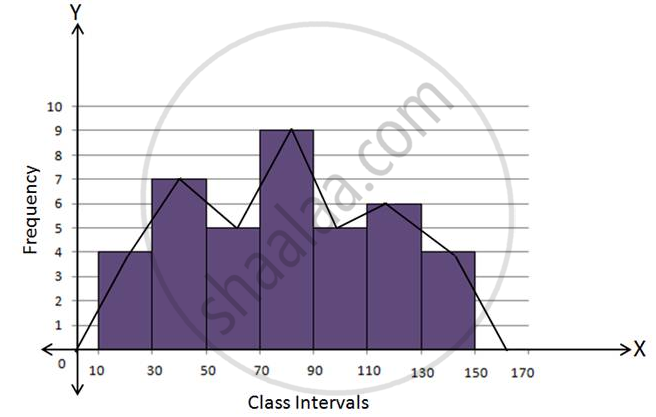
Without using Histogram:

Steps: 

  1. Find the class-mark (mid-value) of each given class-interval.
    classmark = mid-value = `" Upper limit + Lower  limit"/2`
  2. On a graph paper, mark class-marks along X-axis and frequencies along Y-axis.
  3. On this graph paper, mark points taking values of class-marks along the X-axis and the values of their corresponding frequencies along Y-axis.

  4. Draw line segments joining the consecutive points marked in step (3) above.
    C.I. Class-mark f
    -10 - 10 0 0
    10 - 30 20 4
    30 - 50 40 7
    50 - 70 60 5
    70 - 90 80 9
    90 - 110 100 5
    110 - 130 120 6
    130 - 150 140 4
    150 - 170 160 0


shaalaa.com
  Is there an error in this question or solution?
Chapter 18: Statistics - Exercise 18 (B) [Page 233]

APPEARS IN

Selina Concise Mathematics [English] Class 9 ICSE
Chapter 18 Statistics
Exercise 18 (B) | Q 5.1 | Page 233

RELATED QUESTIONS

The length of 40 leaves of a plant are measured correct to one millimetre, and the obtained data is represented in the following table:-

Length (in mm) Number of leaves
118 - 126 3
127 - 135 5
136 - 144 9
145 - 153 12
154 - 162 5
163 - 171 4
172 - 180
  1. Draw a histogram to represent the given data. [Hint: First make the class intervals continuous]
  2. Is there any other suitable graphical representation for the same data?
  3. Is it correct to conclude that the maximum number of leaves are 153 mm long? Why?

The runs scored by two teams A and B on the first 60 balls in a cricket match are given below:

Number of balls Team A Team B
1 - 6 2 5
7 - 12 1 6
13 - 18 8 2
19 - 24 9 10
25 - 30 4 5
31 - 36 5 6
37 - 42 6 3
43 - 48 10 4
49 - 54 6 8
55 - 60 2 10

Represent the data of both the teams on the same graph by frequency polygons.

[Hint: First make the class intervals continuous.]


A random survey of the number of children of various age groups playing in a park was found as follows:

Age (in years) Number of children
1 - 2 5
2 - 3 3
3 - 5 6
5 - 7 12
7 - 10 9
10 - 15 10
15 - 17 4

Draw a histogram to represent the data above.


The bar graph shown in Fig 23.16 represents the circulation of newspapers in 10 languages. Study the bar graph and answer the following questions:

(i) What is the total number of newspapers published in Hindi, English, Urdu, Punjabi and Bengali?
(ii) What percent is the number of news papers published in Hindi of the total number of newspapers?
(iii) Find the excess of the number of newspapers published in English over those published in Urdu.
(iv) Name two pairs of languages which publish the same number of newspapers.
(v) State the language in which the smallest number of newspapers are published.
(vi) State the language in which the largest number of newspapers are published.
(vii) State the language in which the number of newspapers published is between 2500 and 3500.
(viii) State whether true or false:
a. The number of newspapers published in Malayalam and Marathi together is less than those published in English.
b. The number of newspapers published in Telugu is more than those published in Tamil.


Explain the reading and interpretation of bar graphs.


The following bar graph shows the results of an annual examination in a secondary school. Read the bar graph  and choose the correct alternative in each of the following:

(i) The pair of classes in which the results of boys and girls are inversely proportional are:
(a) VI, VIII (b) VI, IX (c) VIII, IX (d) VIII, X
(ii) The class having the lowest failure rate of girls is
(a) VII (b) X (c) IX (d) VIII
(iii)The class having the lowest pass rate of students is
(a) VI (b) VII (c) VIII (d) IX


The population of Delhi State in different census years is as given below:
 

Census year 1961 1971 1981 1991 2001
Population in Lakhs 30 55 70 110 150

Construct a histogram for the following data:

Monthly School
fee (in Rs):
30-60 60-90 90-120 120-150 150-180 180-210 210-240
No of Schools 5 12 14 18 10 9 4

The following is the distribution of total household expenditure (in Rs.) of manual worker in a city:

Expenditure
(in Rs):
100-150 150-200 200-250 250-300 300-350 350-400 400-450 450-500
No. of manual workers: 25 40 33 28 30 22 16 8

Draw a histogram and a frequency polygon representing the above data.


Is it correct to say that in a histogram, the area of each rectangle is proportional to the class size of the corresponding class interval? If not, correct the statement.


Share
Notifications

Englishहिंदीमराठी


      Forgot password?
Use app×