Advertisements
Advertisements
Question
Draw an electron dot diagram to show the formation of each of the following compounds:
Magnesium Chloride
[H = 1, C = 6, Mg = 12, Cl = 17]
Advertisements
Solution
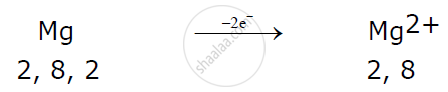
Magnesium atom loses 2 electrons to attain a stable electronic configuration and becomes a cation.
Example:
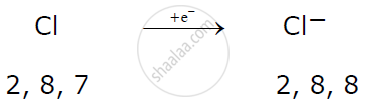
A non-metallic atom like chlorine gains 1 electron to attain a stable electronic configuration and becomes an anion.
Example:
Cations and anions are oppositely charged particles which attract one another to form an electrovalent bond leading to the formation of an electrovalent compound
Here magnesium donates one electron each with two chlorine atoms resulting in the formation of magnesium chloride.

APPEARS IN
RELATED QUESTIONS
Give one word or phrase for the following:
The amount of energy released when an atom in the gaseous state accepts an electron to form an anion.
Give reason:
Electron affinity of halogens is comparatively high ?
Which has higher E.A. fluorine or Neon?
Arrange the following according to the instruction given in the bracket:
F, B, N, O (In the increasing order of electron affinity).
A, B, C are three elements in which B is an inert gas other than helium. With this information complete the following table.
| Element | Atomic number | No. of electrons in the valence shell | Group to which the element belongs |
| A | Z − 1 | - | - |
| B | Z | - | - |
| C | Z + 1 | - | - |
Also, explain the following:
- Electron affinity of element A is more than that of element C.
- lonization energy of element C is less than that of element A.
- Electron affinity of B is zero.
A, B, C are three elements in which B is an inert gas other than helium.With this information complete the following table.
| Element | Atomic number | No. of electrons in the valence shell | Group to which the element belongs |
| A | Z - 1 | ||
| B | Z | ||
| C | Z + 1 |
Also, explain the following : Electron affinity of B is Zero.
Fill in the blank
Noble gases have ______ electron affinity.
Arrange the following in increasing order of property indicated
F, Cl, Br, I (electron affinity)
Neon shows zero electron affinity due to ______.
In Period 3 of the Periodic Table, element B is placed to the left of element A. On the basis of this information, choose the correct word from the option to complete the following statement:
The element A would probably have ______ electron affinity than B.
