Advertisements
Advertisements
प्रश्न
Draw an electron dot diagram to show the formation of each of the following compounds:
Magnesium Chloride
[H = 1, C = 6, Mg = 12, Cl = 17]
Advertisements
उत्तर
Magnesium atom loses 2 electrons to attain a stable electronic configuration and becomes a cation.
Example:
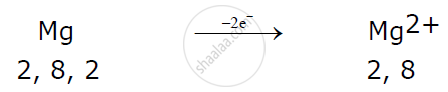
A non-metallic atom like chlorine gains 1 electron to attain a stable electronic configuration and becomes an anion.
Example:
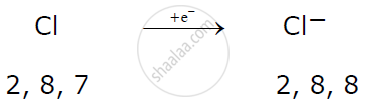
Cations and anions are oppositely charged particles which attract one another to form an electrovalent bond leading to the formation of an electrovalent compound
Here magnesium donates one electron each with two chlorine atoms resulting in the formation of magnesium chloride.

APPEARS IN
संबंधित प्रश्न
Draw an electron dot diagram to show the formation of the following compound:
Methane
[H = 1, C = 6]
Arrange the elements of second period in increasing order of their electron affinity. Name the elements which do not follow the trend in this period.
Electron affinity values generally _______ across the periods left to right and ______ down the group top to bottom.
What is electron affinity?
Choose the correct answer:
Among the period 2 elements the one which has high electron affinity is
Down a group, electron affinity ______ [increases, decreases, remains same].
Among the Period 2 elements, the element which has high electron affinity is
The electron affinity of an element X is greater than that of element Y.
How is the electronegativity of X likely to compare with that of Y?
The electron affinity of an element X is greater than that of element Y.
State whether X is likely to be placed to the left or to the right of Y in the periodic table.
State electron affinity unit.
