Advertisements
Advertisements
प्रश्न
Draw an electron dot diagram to show the formation of each of the following compounds:
Magnesium Chloride
[H = 1, C = 6, Mg = 12, Cl = 17]
Advertisements
उत्तर
Magnesium atom loses 2 electrons to attain a stable electronic configuration and becomes a cation.
Example:
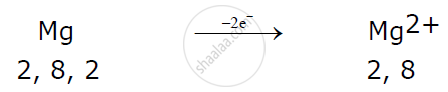
A non-metallic atom like chlorine gains 1 electron to attain a stable electronic configuration and becomes an anion.
Example:
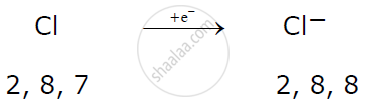
Cations and anions are oppositely charged particles which attract one another to form an electrovalent bond leading to the formation of an electrovalent compound
Here magnesium donates one electron each with two chlorine atoms resulting in the formation of magnesium chloride.

APPEARS IN
संबंधित प्रश्न
Choose the correct answer from the options given below:
If an element A belongs to Period 3 and Group II, then it will have
A. 3 shells and 2 valence electrons
B. 2 shells and 3 valence electrons
C. 3 shells and 3 valence electrons
D. 2 shells and 2 valence electrons
Give reason:
Electronegativity of chorine is higher than Sulphur?
Arrange the elements of group 17 and group 1 according to the given conditions.
Increasing electron affinity
Why is the electron affinity of fluorine less than chlorine?
Fill in the blank
Energy released when electron is added to a neutral gaseous atom is called ______.
State whether the following statement is true or false
Al2O3 is an amphoteric oxide.
What is electron affinity?
With reference to the variation of properties in the Periodic Table, which of the following is generally true?
Electron affinity increases going down a group.
Choose the correct answer:
Among the period 2 elements the one which has high electron affinity is
In a period, increase in electron affinity increases ______.
