Advertisements
Advertisements
Question
Draw a straight-line demand curve joining both the axes. Indicate the following on the demand curve.
Elasticity of demand is equal to zero
Advertisements
Solution
A straight-line demand curve joining both the axes is shown below:

The elasticity of demand is different at different points.
`"measured by Elasticity" = "Lower segment of demand curve"/ "Upper segment of demand curve"`
The elasticity of demand is equal to zero at point A on the diagram, as the lower segment is zero.
APPEARS IN
RELATED QUESTIONS
Explain the law of demand with its assumptions.
Explain the effect of change in prices of the related goods on demand for the given good.
Market of a commodity is in equilibrium. Demand for the commodity "increases." Explain the chain of effects of this change till the market again reaches equilibrium. Use diagram.
What does a rightward shift of demand curve indicate?
Fill in the blank using proper alternative given in the bracket:
Market demand is a total demand of...............buyers.
Define or explain the following concept.
Market Demand .
State with reason, whether you Agree or Disagree with the following statement.
The demand curve slopes downward from left to right.
State with reasons whether you ‘agree’ or ‘disagree’ with the following statement.
Demand curve slopes downward from left to right.
Statements related to decrease in demand
- It is a type of change in demand
- It takes place due to unfavourable changes in other factors like tastes, income etc.
- Price remains constant
- Demand curve shifts to the right hand side of the original demand curve
Assertion (A): Under exceptional cases, demand curve has a positive slope.
Reasoning (R): In exceptional cases, consumer buys more when the price of a commodity rises and buys less when the price of commodity falls.
The shape of supply curve is ______
The demand curve for foreign exchange is ______
Study the following table and answer the questions:
| Price of Ice Cream (₹) | Quantity Supplied | Market Supply | ||
| Seller A | Seller B | Seller C | (A + B + C) | |
| 50 | 0 | 2 | 5 | 7 |
| 100 | 1 | `square` | 10 | 15 |
| 150 | `square` | 6 | 15 | 23 |
| 200 | 3 | 8 | 20 | `square` |
| 250 | 4 | 10 | `square` | 39 |
Questions:
- Complete the above table.
- State whether the following statements are True or False.
(a) Market supply has a direct relation to price.
(b) As the price rises from ₹50 to ₹250, market supply rises from 7 to 39. This indicates an increase in supply.
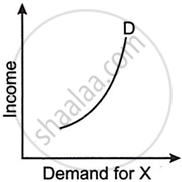
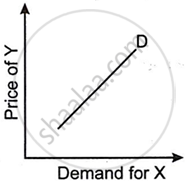
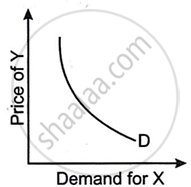
Figures (A), (B) and (C) given below represent different types of Demand curves.
 |
 |
 |
| (A) | (B) | (C) |
What kind of goods do each of these Demand curves represent? Give a reason for each of the curves.
What does the downward slope of the demand curve indicate?
How is the market demand curve constructed from individual demand curves?
What causes movement along the demand curve, not a shift of the curve?
