Advertisements
Advertisements
Question
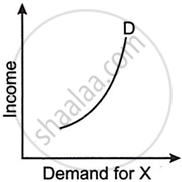
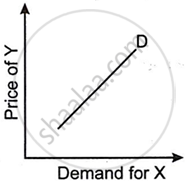
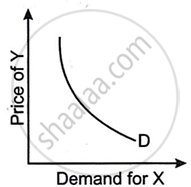
Figures (A), (B) and (C) given below represent different types of Demand curves.
 |
 |
 |
| (A) | (B) | (C) |
What kind of goods do each of these Demand curves represent? Give a reason for each of the curves.
Advertisements
Solution
Figure (A) shows a demand curve that slopes upward with income on the Y-axis and Demand for X on the X-axis, representing normal items whose demand increases as the consumer's income rises.
Figure (B) shows a straight upward sloping demand curve with Demand for X on the X-axis and Price of Y on the Y-axis, representing substitute goods. As the price of the substitute goods increases, so does the demand for the other goods.
Figure (C) shows demand for X on the X-axis and price for Y on the Y-axis, with the demand curve representing demand for complementary items, where an increase in the price of complementary goods causes a decrease in demand for other goods and vice versa.
APPEARS IN
RELATED QUESTIONS
When does ‘increase’ in demand take place?
Distinguish between individuals demand and market demand.
If with the rise in the price of good Y, demand for good X rises, the two goods are: (Choose the correct alternative)
a. Substitutes
b. Complements
c. Not related
d. Jointly demanded
What does a rightward shift of demand curve indicate?
Fill in the blank using proper alternative given in the bracket:
Market demand is a total demand of...............buyers.
Define or explain the following concept.
Market Demand .
State with reason, whether you Agree or Disagree with the following statement.
The demand curve slopes downward from left to right.
Write explanatory notes or answer the following.
Aggregate demand
Do you agree with the following statement? Give reason
State and explain the law of demand.
State with reasons whether you ‘agree’ or ‘disagree’ with the following statement.
Demand curve slopes downward from left to right.
Statements related to decrease in demand
- It is a type of change in demand
- It takes place due to unfavourable changes in other factors like tastes, income etc.
- Price remains constant
- Demand curve shifts to the right hand side of the original demand curve
Assertion (A): Under exceptional cases, demand curve has a positive slope.
Reasoning (R): In exceptional cases, consumer buys more when the price of a commodity rises and buys less when the price of commodity falls.
In case of perfect competition, AR curve is:
Explain why the demand curve slopes downwards.
Study the following table and answer the questions:
| Price of Ice Cream (₹) | Quantity Supplied | Market Supply | ||
| Seller A | Seller B | Seller C | (A + B + C) | |
| 50 | 0 | 2 | 5 | 7 |
| 100 | 1 | `square` | 10 | 15 |
| 150 | `square` | 6 | 15 | 23 |
| 200 | 3 | 8 | 20 | `square` |
| 250 | 4 | 10 | `square` | 39 |
Questions:
- Complete the above table.
- State whether the following statements are True or False.
(a) Market supply has a direct relation to price.
(b) As the price rises from ₹50 to ₹250, market supply rises from 7 to 39. This indicates an increase in supply.
What does the downward slope of the demand curve indicate?
How is the market demand curve constructed from individual demand curves?
