Advertisements
Advertisements
Question
Draw a line segment PQ = 4.8 cm. Construct the perpendicular bisector of PQ.
Advertisements
Solution
Steps of Construction :
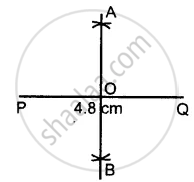
- Draw a line segment PQ = 4.8 cm.
- With P as centre and radius equal than half of PQ, draw an arc on both the PQ.
- With Q as the centre and the same radius as taken in step 2, draw arcs on both sides of PQ.
- Let the arcs intersect each other at point A and B
- Join A and B.
- The line AB cuts the line segment PQ at the point O. Here OP = OQ and ∠AOQ = 90°. Then the line AB is a perpendicular bisector of PQ.
APPEARS IN
RELATED QUESTIONS
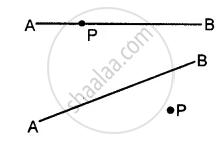
In each of the following, draw perpendicular through point P to the line segment AB :
(i)

(ii)

(iii)
Draw a line segment AB = 5.5 cm. Mark a point P, such that PA = 6 cm and PB = 4.8 cm. From point P, draw a perpendicular to AB.
The line of symmetry of a line segment is the ______ bisector of the line segment.
Only one perpendicular bisector can be drawn to a given line segment.
Infinitely many perpendiculars can be drawn to a given ray.
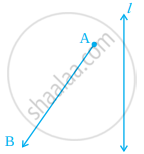
Draw the images of points A and B in line l of figure and name them as A’ and B’ respectively. Measure AB and A’B’. Are they equal?
Draw a line segment of length 6.5 cm and divide it into four equal parts, using ruler and compasses.
Copy figure on your notebook and draw a perpendicular to l through P, using (i) set squares (ii) protractor (iii) ruler and compass. How many such perpendiculars are you able to draw?

What property defines the Uniqueness of the perpendicular bisector?
If a line passes through the midpoint of segment AB but does not form a 90° angle, it is:
