Advertisements
Advertisements
Question
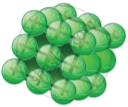
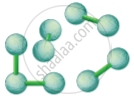
Distinguish the properties of solid, liquid, and gas. Draw a suitable diagram.
Advertisements
Solution
| S.No. | Solid | Liquid | Gas |
| 1. | Definite shape and volume | No definite shape, it attains the shape of the vessel | it has neither a definite shape nor a definite volume. |
| 2. | Incompressible | Compressible to a small extent | Highly compressible. |
| 3. | Little space between the particles | Greater space between the particles | Greater space between the particles. |
| 4. | Particles cannot move freely | Particles move freely | Particles are in a continuous, random motion. |
| 5. |
Particles in a Solid
Eg. Stone |
Particles in a Liquid
Eg. Water |
Particles in a Gas
Eg. Air |

APPEARS IN
RELATED QUESTIONS
Classify the following into solids, liquids and gases.
Oxygen, milk, common salt, wax, stone, L.P.G, carbon- dioxide, sugar, mercury, coal, blood, butter, copper, coconut oil, kerosene.
Write whether the following statement is true or false:
If the container in which a gas is collected has an opening, the gas will flow out and spread itself indefinitely
The three main states of matter are solids, liquids, and gases. Compare the three states with reference to the following characteristics of matter
(a) volume
(b) shape
(c) compressibility
(d) diffusion.
Describe simple experiments to prove that liquids have mass
Describe simple experiments to prove that liquids have no definite shape
State the property of the following substance.
Sodium nitrate is soluble in water, but calcium carbonate is not.
Filtration method is effective in separating ______ mixture.
Complete the given analogy.
Solid: Rigidity:: Gas: ______
Intermolecular forces of attractions are maximum in ______.
The density of solid Argon is 1.6 ml at - 233°C. If the Argon atom is assumed to be sphere of radius 1.5 × 10⁻⁸ cm, then the ______ % of solid Argon is apparently occupied.
[Take : NA = 6 × 10²³, Atomic mass of Ar = 40]
