English

Distinguish between myopia and hypermetropia. Show diagrammatically how these defects can be corrected. - Physics

Advertisements
Advertisements

Question

Distinguish between myopia and hypermetropia. Show diagrammatically how these defects can be corrected.

Advertisements

Solution

• Nearsightedness or Myopia − A person suffering from myopia can see only nearby objects clearly, but cannot see the objects beyond a certain distance clearly.

Myopic eye:
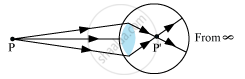
Correction − In order to correct the eye for this defect, a concave lens of suitable focal length is placed close to the eye so that the parallel ray of light from an object at infinity after refraction through the lens appears to come from the far point P'of the myopic eye.
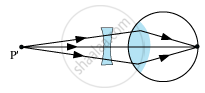
• Farsightedness or Hypermetropia − A person suffering from hypermetropia can see distant objects clearly, but cannot see nearby objects.

Hypermetropic eye:
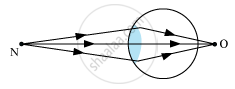
Correction − To correct this defect, a convex lens of suitable focal length is placed close to the eye so that the rays of light from an object placed at the point N after refraction through the lens appear to come from the near point N'of the hypermetropic eye.

shaalaa.com
  Is there an error in this question or solution?
2012-2013 (March) Delhi Set 2

RELATED QUESTIONS

If this telescope is used to view the moon, what is the diameter of the image of the moon formed by the objective lens ? the diameter of the moon is 3.48 × 10⁶ m and the radius of lunar orbit is 3.8 × 10⁸m.


Why must both the objective and the eyepiece of a compound microscope have short focal lengths?


Define the magnifying power of a compound microscope when the final image is formed at infinity. Why must both the objective and the eyepiece of a compound microscope has short focal lengths? Explain.


A compound microscope has an objective of focal length 1.25 cm and eyepiece of focal length 5 cm. A small object is kept at 2.5 cm from the objective. If the final image formed is at infinity, find the distance between the objective and the eyepiece ?


A man is looking at a small object placed at his near point. Without altering the position of his eye or the object, he puts a simple microscope of magnifying power 5 X before his eyes. The angular magnification achieved is


Can the image formed by a simple microscope be projected on a screen without using any additional lens or mirror?


compound microscope consists of two convex lenses of focal length 2 cm and 5 cm. When an object is kept at a distance of 2.1 cm from the objective, a virtual and magnified image is fonned 25 cm from the eye piece.  Calculate the magnifying power of the microscope.


A microscope is focussed on a mark on a piece of paper and then a slab of glass of thickness 3 cm and refractive index 1.5 is placed over the mark. How should the microscope be moved to get the mark in focus again?


The near vision of an average person is 25 cm. To view an object with an angular magnification of 10, what should be the power of the microscope?


With the help of a ray diagram, show how a compound microscope forms a magnified image of a tiny object, at least distance of distinct vision. Hence derive an expression for the magnification produced by it.


Share
Notifications

Englishहिंदीमराठी


      Forgot password?
Use app×