मराठी

Distinguish between myopia and hypermetropia. Show diagrammatically how these defects can be corrected. - Physics

Advertisements
Advertisements

प्रश्न

Distinguish between myopia and hypermetropia. Show diagrammatically how these defects can be corrected.

Advertisements

उत्तर

• Nearsightedness or Myopia − A person suffering from myopia can see only nearby objects clearly, but cannot see the objects beyond a certain distance clearly.

Myopic eye:
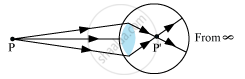
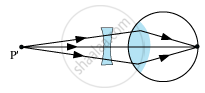
Correction − In order to correct the eye for this defect, a concave lens of suitable focal length is placed close to the eye so that the parallel ray of light from an object at infinity after refraction through the lens appears to come from the far point P'of the myopic eye.
• Farsightedness or Hypermetropia − A person suffering from hypermetropia can see distant objects clearly, but cannot see nearby objects.

Hypermetropic eye:
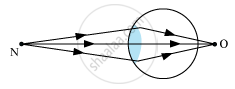
Correction − To correct this defect, a convex lens of suitable focal length is placed close to the eye so that the rays of light from an object placed at the point N after refraction through the lens appear to come from the near point N'of the hypermetropic eye.

shaalaa.com
  या प्रश्नात किंवा उत्तरात काही त्रुटी आहे का?
2012-2013 (March) Delhi Set 2

व्हिडिओ ट्यूटोरियलVIEW ALL [2]

संबंधित प्रश्‍न

Explain the basic differences between the construction and working of a telescope and a microscope


If this telescope is used to view the moon, what is the diameter of the image of the moon formed by the objective lens ? the diameter of the moon is 3.48 × 10⁶ m and the radius of lunar orbit is 3.8 × 10⁸m.


A person with a normal near point (25 cm) using a compound microscope with the objective of focal length 8.0 mm and an eyepiece of focal length 2.5 cm can bring an object placed at 9.0 mm from the objective in sharp focus. What is the separation between the two lenses? Calculate the magnifying power of the microscope.


A compound microscope uses an objective lens of focal length 4 cm and eyepiece lens of focal length 10 cm. An object is placed at 6 cm from the objective lens. Calculate the magnifying power of the compound microscope. Also calculate the length of the microscope.


Draw the labelled ray diagram for the formation of image by a compound microscope.

Derive the expression for the total magnification of a compound microscope. Explain why both the objective and the eyepiece of a compound microscope must have short focal lengths.


A compound microscope forms an inverted image of an object. In which of the following cases it it likely to create difficulties? 


An object is to be seen through a simple microscope of focal length 12 cm. Where should the object be placed so as to produce maximum angular magnification? The least distance for clear vision is 25 cm.


Can the image formed by a simple microscope be projected on a screen without using any additional lens or mirror?


A simple microscope using a single lens often shows coloured image of a white source. Why?


Draw a labelled ray diagram showing the formation of image by a compound microscope in normal adjustment. Derive the expression for its magnifying power.


Share
Notifications

Englishहिंदीमराठी


      Forgot password?
Use app×