Advertisements
Advertisements
Question
Advertisements
Solution
| Longitudinal waves | Transverse waves |
| 1. As it travels through a medium, the particles of the medium vibrate to and fro about their mean positions along the direction of propagation of wave. 2. As the wave propagates through the medium, it causes compressions and rarefactions. 3. In case of longitudinal waves, one wavelength contains one compression and one rarefaction. 4. They can travel through all media i.e. solids, liquids and gases. 5. As the longitudinal wave propagates through a medium, there is change in density of the medium. |
1. As it travels through a medium, the particles of the medium vibrate perpendicular to the direction of propagation of wave. 2. As the wave propagates through the medium, it produces crests and troughs. 3. In case of transverse waves, one wavelength contains one crest and one trough. 4. They can travel only through solids and on the surface of liquids. 5. As the transverse wave travels through a medium, there is no change in density of the medium. |
APPEARS IN
RELATED QUESTIONS
Why is sound wave called a longitudinal wave?
Write true or false for a given statement.
A ticking clock sound is heard late when heard through a metal.
What is a longitudinal wave ?
What is loudness of sound? What factors does it depend on?
What type of wave is represented :
(a) by density-distance graph?
(b) by displacement-distance graph?
In which medium the speed of sound is more: humid air or dry air? Give a reason to your answer.
For which range of frequencies, human ears are most sensitive?
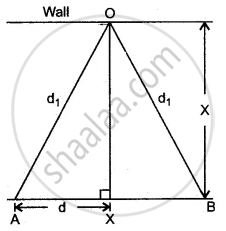
A cannon is fired at A (see diagram). An observer at B hears two sounds. The first sound is heard after 1 second and the second 3s after the observer sees the flash. (Velocity of sound = 340 ms−1)
(i) Why does the observer see the flash before he hears the sound?
(ii) Calculate the distance x between the observer and the wall.
Sound is a ______ wave and needs a material medium to travel.
