Advertisements
Advertisements
Question
Distinguish between: Autotrophic nutrition and Heterotrophic nutrition.
Advertisements
Solution
| Autotrophic nutrition | Heterotrophic nutrition |
| 1. It is the mode of nutrition in which organisms produce their own organic food. | It is the mode of nutrition in which organisms depend on other organisms for their food. |
| 2. Organisms producing their own food are known as autotrophs. | Organisms depending on others for food are known as heterotrophs. |
| 3. Autotrophs use simple inorganic substances present in the surroundings to produce food. | Heterotrophs depend on other organisms to get their food. |
| E.g. Plants | E.g. Fungi |
APPEARS IN
RELATED QUESTIONS
The autotrophic mode of nutrition requires ______.
How would you test the presence of starch in leaves?
Show with the help of a sketch that the plants are the ultimate source of food.
Name two inorganic substances which are used by autotrophs to make food.
Apart from sunlight and chlorophyll, what other things are required to make food by photosynthesis?
Name the green pigment present in the leaves of a plant.
State the various steps involved in the process of photosynthesis.
How does carbon dioxide from the air enter the leaves of a plant to be used in photosynthesis?
How does water from the soil reach the leaves of a plant to be used in photosynthesis?
What will happen to the rate of photosynthesis in a plant under the following circumstances?
Cloudy day in morning but bright sunshine in the afternoon.
Name the raw materials required for photosynthesis. How do plants obtain these raw materials?
The oxygen liberated during photosynthesis by green plants comes from ______.
Explain why, plants have low energy needs as compared to animals.
Which of the following statements about the autotrophs is incorrect?
Differentiate between an autotroph and a heterotroph.
Match Group (A) with Group (B)
| Group A | Group B |
| (a) Autotrophic nutrition | (i) Leech |
| (b) Heterotrophic nutrition | (ii) Paramecium |
| (c) Parasitic nutrition | (iii) Deer |
| (d) Digestion in food vacuoles | (iv) Green plant |
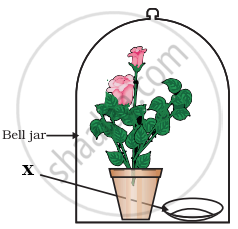
Observe the experimental setup shown below. Name the chemical indicated as ‘X’ that can absorb the gas which is evolved as a byproduct of respiration.