Advertisements
Advertisements
Question
Discuss the important features of the law of gravitation.
Advertisements
Solution
1. As the distance between two masses increases, the strength of the force tends to decrease because of inverse dependence on r2. Physically it implies that the planet Uranus experiences less |F| gravitational force from the Sun than the Earth since Uranus is at a larger distance from the Sun compared to the Earth.
2. The gravitational forces between two particles always constitute an action-reaction pair. It implies that the gravitational force exerted by the Sim on the Earth is always towards the Sun. The reaction force is exerted by the Earth on the Sun. The direction of this reaction force is towards Earth.
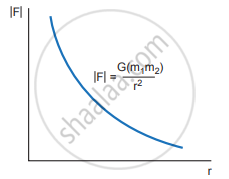
Variation of gravitational force with distance
3. The torque experienced by the Earth due to the gravitational force of the Sun is given by
`vecτ = vec"r" xx vec"F" = vec"r" xx (-("GM"_"S""M"_"E")/"r"^2 hat"r") = 0`
Since `vec"r" = "r", hat"r", (hat"r" xx hat"r") = 0`
So `vecτ = ("d" vec"L")/"dt" = 0`
It implies that angular momentum `vec"L"` is a constant vector.
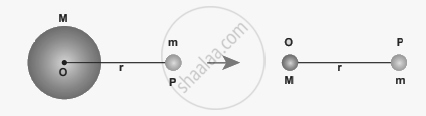
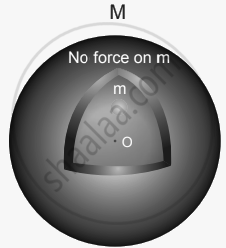
Hollow sphere of mass
4. The expression `vec"F" = -("GM"_1"M"_2)/"r"^2 hat"r""` has one inherent assumption that both M1, and M2 are treated as point masses. When it is said that Earth orbits around the Sun due to Sun’s gravitational force, we assumed Earth and Sun to be point masses.
5. Point masses hold even for a small distance.
6. There is also another interesting result. Consider a hollow sphere of mass M. If we place another object of mass ‘m’ inside this hollow sphere the force experienced by this mass ‘m’ will be zero.
APPEARS IN
RELATED QUESTIONS
The value of acceleration due to gravity is maximum at ________.
The gravitational potential due to the Earth is minimum at _______.
State Kepler’s three laws.
State Newton’s Universal law of gravitation.
If the angular momentum of a planet is given by `vec"L" = 5"t"^2hat"i" - 6"t"hat"j" + 3hat"k"`. What is the torque experienced by the planet? Will the torque be in the same direction as that of the angular momentum?
The escape velocity of a body on a planet 'A' is 12 kms–1. The escape velocity of the body on another planet 'B', whose density is four times and radius is half of the planet 'A', is ______.
The time period of a satellite revolving around the earth in a given orbit is 7 hours. If the radius of the orbit is increased to three times its previous value, then the approximate new time period of the satellite will be ______.
Four identical particles of mass M are located at the corners of a square of side 'a'. What should be their speed if each of them revolves under the influence of the other's gravitational field in a circular orbit circumscribing the square?

Which of the following statements is NOT a characteristic of gravitational force as described in the source?
Who described Earth’s rotation and orbits before Newton?
