Advertisements
Advertisements
Question
Directions: Read the statements and presume that whatever statements given are true.
On the basis of that, choose the most appropriate conclusion(s) given below.
Statements:
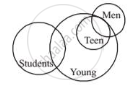
All the students are young. All the teens are young. Some men are teens.
Conclusions:
I. Some students are teens.
II. Some young are students.
III. Some young are men.
Options
Only (I) follows
Only (II) and (III) follow
Only (I) and (II) follow
Only (I) and (III) follow
Advertisements
Solution
Only (II) and (III) follow
APPEARS IN
RELATED QUESTIONS
In this Question, problem consists of a set of rules and facts. Apply the specified rules to the set of facts and answer the question. In answering the following question, you should not rely on any rule(s) except the rule(s) that are supplied for problem. Further, you should not assume any fact other than 'those stated in the problem. The aim is to test your ability to properly apply a rule to a given set of facts, even when the result is absurd or unacceptable for any other reason. It is not the aim to test any knowledge of law you may already possess. Rules A. A person is an employee of another if the mode and the manner in which he or she carries out his work is subject to control and supervision of the latter. B. An employer is required to provide compensation to his or her employees for any injury caused by an accident arising in the course of employment. The words 'in the course of the employment' means in the course of the work which the employee is contracted to do and which is incidental to it. Facts Messrs. ZafarAbidi and Co. (Company) manufactures bidis with the help of persons known as `pattadars'. The pattadars are supplied tobacco and leaves by the Company and are required to roll them into bidis and bring the bidis back to the Company. The pattadars are free to roll the bidis either in the factory or anywhere else they prefer. They are not bound to attend the factory for any fixed hours of work or for any fixed number of days. Neither are they required to roll up any fixed number of bidis. The Company verifies whether the bidis adhere to the specified instructions or not and pays the pattadars on the basis of the number of bids that are found to be of right quality. Aashish Mathew is one of the pattadars of the Company. He was hit by a car just outside the precinct of the factory while he was heading to have lunch in a nearby foodstall. Aashish Mathew has applied for compensation from the Company. In case the patladars were compulsorily required to work in the factory for a minimum number of hours every day, then it would be correct to state that:
In this Question problem consists of a set of rules and facts. Apply the specified rules to the set of facts and answer the question. In answering the following question, you should not rely on any rule(s) except the rule(s) that are supplied for problem. Further, you should not assume any fact other than 'those stated in the problem. The aim is to test your ability to properly apply a rule to a given set of facts, even when the result is absurd or unacceptable for any other reason. It is not the aim to test any knowledge of law you may already possess.
Rule A: When a State undertakes any measure, the effects of the measure must be the same for all those who are affected by it.
Rule B: When a State undertakes any measure, everyone affected must have an equal chance to benefit from it.
Facts 100 mountaineers embarked on an extremely risky climbing expedition in Leh. Weather conditions worsened five days into the expedition and the mountaineers are trapped under heavy snow. The government received information of this tragedy only two weeks after the unfortunate incident and has only 24 hours in which to send rescue helicopters. Weather stations across the world confirm that this particular region of Leh will experience blizzards of unprecedented intensity for almost two weeks after this 24 hour window rendering any helicopter activity in the region impossible and certain death for anyone left behind. The government has only five rescue helicopters with a maximum capacity of 50 people (excluding pilots and requisite soldiers) and these helicopters can fly only once in 24 hours to such altitudes. As the Air Force gets ready to send the helicopters, an emergency hearing is convened in the Supreme Court to challenge this measure as this would leave 50 people to die. If you were the judge required to apply Rule A, you would decide that:
In the event of non-enforcement of Directive Principles of the State by the Government, a citizen of India can move the
The principle is to be applied to the given facts and to choose the most appropriate option:
Principle: According to the law of trade unions in India, no suit or other legal proceeding shall be maintainable in any civil court against any registered trade union or any officer or member thereof in respect of any act done in contemplation or in furtherance of a trade dispute.
Facts: Soloman, the Secretary of a registered Trade Union took a loan from a bank for the higher education of his daughter. Soon after completing the course she was married to an NRI Engineer. Solomon did not repay the loan. The Bank demanded the payments from Soloma n and warned him that the Bank will take suitable legal action against him. Identify the legal position in this regard.
The principle is to be applied to the given facts and to choose the most appropriate option:
Principle: According to Sec. 2 of the Industrial Disputes Act, 1947, ‘Industrial dispute means any dispute or difference between employers and employers or between employers and workmen or between workmen and workmen, which is connected with the employment or non employment or the terms of employment or with the conditions of labour of any person’.
Facts: Sunder agreed to take Bhola’s penthouse on rent for three years at the rate of rupees 12, 00, 000/ per annum provided the house was put to thorough repairs and the living rooms were decorated according to contemporary style.
India’s Personal Data Protection Bill, 2019 (‘Bill’) starts encouragingly, seeking to protect “the privacy of individuals relating to their personal data”. But by the end, it is clear it is not designed to deliver on the promise. For, even as it rightly requires handlers of data to abide by globally-accepted rules — about getting an individual’s consent first — it disappointingly gives wide powers to the Government to dilute any of these provisions for its agencies.
Recently, messaging platform WhatsApp said that some Indian journalists and rights activists were among those spied on using technology made by an Israeli company, which by its own admission only works for government agencies across the world.
Importantly, one of the first to raise a red flag about Bill’s problematic clauses was Justice B.N. Srikrishna, whose committee’s report forms the basis of the Bill. He has used words such as “Orwellian” and “Big Brother” in reaction to the removal of safeguards against actions of Government agencies. In its report last July, the committee noted that the dangers to privacy originate from state and non-state actors. It, therefore, called for exemptions to be “watertight”, “narrow”, and available for use in “limited circumstances”. It had also recommended that the Government bring in a law for the oversight of intelligence-gathering activities, the means by which non-consensual processing of data takes place. A related concern about the Bill is regarding the constitution of the Data Protection Authority of India (‘DPA’), which is to monitor and enforce the provisions of the Act. It will be headed by a chairperson and have not more than six whole-time members, all of whom are to be selected by a panel filled with Government nominees. This completely disregards the fact that Government agencies are also regulated under the Bill; they are major collectors and processors of data themselves. The sweeping powers the Bill gives to the Government render meaningless the gains from the landmark K.S. Puttaswamy vs. Union of India case, which culminated in the recognition that privacy is intrinsic to life and liberty, and therefore a basic right. That idea of privacy is certainly not reflected in the Bill in its current form.
According to the passage, the committee headed by Justice B. N. Srikrishna called for:
Last week, the government used the Drug Price Control Order, 2013, to increase the price ceiling for 21 medicines by as much as 50% to ensure their availability in the market. This is a welcome move because lower prices would have further limited the availability of these drugs, some of which include those used for malaria, leprosy and allergy. The decision by the regulatory authority – usually known to reduce prices of essential drugs – was prompted by repeated petitions by the pharmaceutical industry, which pointed out that the increasing cost of imports had made the production of some of these drugs unviable. Prices of bulk drugs and active pharmaceutical ingredients have, in fact, gone up by up to 88%, and are largely imported.
This raises a basic question: Should the government control prices? The motivation for controlling drug prices is not very difficult to understand. Unlike some of the developed countries, where most of the population has insurance coverage or medical facilities are provided by the state, medical expenses in India are borne by citizens, largely through out-of-pocket expenses. Therefore, the state intervenes by keeping prices of some drugs in check to contain such spending. However, the unintended consequence is that it affects the supply of drugs and can potentially make citizens worse off. The risk of non-availability was an important reason for raising prices. Although all pharmaceutical companies may not stop producing drugs with price control, they may limit the supply. Further, the government usually dithers on price hike because of political considerations so that it is not accused of favouring private companies.
Thus, the government should stay away from dictating prices and allow the market to function. Competition in the marketplace will ensure that no company is able to make extraordinary profits in basic and essential drugs. Since the state has limited resources, it should focus on regulation, and ensure that the quality of drugs supplied in the market is not compromised at any point.
Based on the author’s arguments in the passage above, which of the following would be most correct:
The design does not include
Year of Digital Millenium Copyright Act
World Intellectual Property Day Celebrated in
