Advertisements
Advertisements
प्रश्न
Directions: Read the statements and presume that whatever statements given are true.
On the basis of that, choose the most appropriate conclusion(s) given below.
Statements:
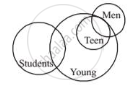
All the students are young. All the teens are young. Some men are teens.
Conclusions:
I. Some students are teens.
II. Some young are students.
III. Some young are men.
पर्याय
Only (I) follows
Only (II) and (III) follow
Only (I) and (II) follow
Only (I) and (III) follow
Advertisements
उत्तर
Only (II) and (III) follow
APPEARS IN
संबंधित प्रश्न
In this Question problem consists of a set of rules and facts. Apply the specified rules to the set of facts and answer the question. In answering the following question, you should not rely on any rule(s) except the rule(s) that are supplied for problem. Further, you should not assume any fact other than 'those stated in the problem. The aim is to test your ability to properly apply a rule to a given set of facts, even when the result is absurd or unacceptable for any other reason. It is not the aim to test any knowledge of law you may already possess.
Rule A: When a State undertakes any measure, the effects of the measure must be the same for all those who are affected by it.
Rule B: When a State undertakes any measure, everyone affected must have an equal chance to benefit from it.
Facts 100 mountaineers embarked on an extremely risky climbing expedition in Leh. Weather conditions worsened five days into the expedition and the mountaineers are trapped under heavy snow. The government received information on this tragedy only two weeks after the unfortunate incident and has only 24 hours in which to send rescue helicopters. Weather stations across the world confirm that this particular region of Leh will experience blizzards of unprecedented intensity for almost two weeks after this 24 hour window rendering any helicopter activity in the region impossible and certain death for anyone left behind. The government has only five rescue helicopters with a maximum capacity of 50 people (excluding pilots and requisite soldiers) and these helicopters can fly only once in 24 hours to such altitudes. As the Air Force gets ready to send the helicopters, an emergency hearing is convened in the Supreme Court to challenge this measure as this would leave 50 people to die. Choosing 50 survivors exclusively by a lottery would be:
In this Question, problem consists of a set of rules and facts. Apply the specified rules to the set of facts and answer the question. In answering the following question, you should not rely on any rule(s) except the rule(s) that are supplied for problem. Further, you should not assume any fact other than 'those stated in the problem. The aim is to test your ability to properly apply a rule to a given set of facts, even when the result is absurd or unacceptable for any other reason. It is not the aim to test any knowledge of law you may already possess.
Rules A: The State shall not discriminate, either directly or indirectly, on the grounds of sex, race, religion, caste, creed, sexual orientation, marital status, disability, pregnancy, place of birth, gender orientation or any other status.
Rule B: Direct discrimination occurs when for a reason related to one or more prohibited grounds a person or group of persons is treated less favourably than another person or another group of persons in a comparable situation.
Rule C: Indirect discrimination occurs when a provision, criterion or practice which is neutral on the face of it would have the effect of putting persons having a status or a characteristic associated with one or more prohibited grounds at a particular disadvantage compared with other persons.
Rule D: Discrimination shall be justified when such discrimination is absolutely necessary in order to promote the well-being of disadvantaged groups, such as women, dalits, religious minorities, sexual minorities or disabled persons.
Facts: On 2"° October 2010, the Governor of the state of Bihar ordered the release of all women prisoners who were serving sentence of less than one-year imprisonment to mark the occasion of Mahatma Gandhi's birthday. Which of the following is correct with respect to the Governor's order?
In this Question problem consists of a set of rules and facts. Apply the specified rules to the set of facts and answer the question. In answering the following question, you should not rely on any rule(s) except the rule(s) that are supplied for problem. Further, you should not assume any fact other than 'those stated in the problem. The aim is to test your ability to properly apply a rule to a given set of facts, even when the result is absurd or unacceptable for any other reason. It is not the aim to test any knowledge of law you may already possess.
Rules A: The State shall not discriminate, either directly or indirectly, on the grounds of sex, race, religion, caste, creed, sexual orientation, marital status, disability, pregnancy, place of birth, gender orientation or any other status.
Rule B: Direct discrimination occurs when for a reason related to one or more prohibited grounds a person or group of persons is treated less favourably than another person or another group of persons in a comparable situation.
Rule C: Indirect discrimination occurs when a provision, criterion or practice which is neutral on the face of it would have the effect of putting persons having a status or a characteristic associated with one or more prohibited grounds at a particular disadvantage compared with other persons.
Rule D: Discrimination shall be justified when such discrimination is absolutely necessary in order to promote the well-being of disadvantaged groups, such as women, dalits, religious minorities, sexual minorities or disabled persons.
Facts: On 2"° October 2010, the Governor of the state of Bihar ordered the release of all women prisoners who were serving a sentence of less than one-year imprisonment to mark the occasion of Mahatma Gandhi's birthday. Assume that the Governor also made a second order requiring the release of all persons under the age of 25 and over the age of 65 who were serving a sentence of less than one year's imprisonment. Under the Rules, this order is:
Who presides over the joint session of Parliament?
In the event of non-enforcement of Directive Principles of the State by the Government, a citizen of India can move the
The purpose of the Ilbert Bill was
Consists of legal proposition(s)/ principle(s) (hereinafter referred to as 'principle') and facts. Such principles may or may not be true in the real and legal sense, yet you have to conclusively assume them to be true for the purposes of this Section. In other words, in answering these questions, you must not rely on any principle except the principles that are given herein below for every question.
Further, you must not assume any facts other than those stated in the question. The objective of this section is to test your interest in the study of law, research aptitude, and problem-solving ability, even if the 'most reasonable conclusion' arrived at may be absurd or unacceptable for any other reason. It is not the objective of this section to test your knowledge of the law.
Therefore, to answer a question, the principle is to be applied to the given facts and to choose the most appropriate option.
Principle: A master shall be liable for the fraudulent acts of his servants committed in the course of employment. However, the master and third parties must exercise reasonable care in this regard.
Facts: Rahul was a door to door salesman with United Manufacturing Company (the Company). The Company was manufacturing Water Purifiers. Rahul, along with the Company’s products, used to carry Water Purifiers manufactured by his Cousin in a local Industrial Estate. He used to sell the local product at a lower rate giving the impression to the buyers that he is offering a discount on the Company’s product. Company Management detected the fraudulent activity of Rahul and dismissed him from service. Rahul still continued to carry on with his activity of selling the local product pretending that he was still a salesman of the Company. Several customers got cheated in this process. The fraud was noticed by the Company when the customer began to complain about the product. The customers demanded the Company to compensate for their loss.
India’s Personal Data Protection Bill, 2019 (‘Bill’) starts encouragingly, seeking to protect “the privacy of individuals relating to their personal data”. But by the end, it is clear it is not designed to deliver on the promise. For, even as it rightly requires handlers of data to abide by globally-accepted rules — about getting an individual’s consent first — it disappointingly gives wide powers to the Government to dilute any of these provisions for its agencies.
Recently, messaging platform WhatsApp said that some Indian journalists and rights activists were among those spied on using technology made by an Israeli company, which by its own admission only works for government agencies across the world.
Importantly, one of the first to raise a red flag about Bill’s problematic clauses was Justice B.N. Srikrishna, whose committee’s report forms the basis of the Bill. He has used words such as “Orwellian” and “Big Brother” in reaction to the removal of safeguards against actions of Government agencies. In its report last July, the committee noted that the dangers to privacy originate from state and non-state actors. It, therefore, called for exemptions to be “watertight”, “narrow”, and available for use in “limited circumstances”. It had also recommended that the Government bring in a law for the oversight of intelligence-gathering activities, the means by which non-consensual processing of data takes place. A related concern about the Bill is regarding the constitution of the Data Protection Authority of India (‘DPA’), which is to monitor and enforce the provisions of the Act. It will be headed by a chairperson and have not more than six whole-time members, all of whom are to be selected by a panel filled with Government nominees. This completely disregards the fact that Government agencies are also regulated under the Bill; they are major collectors and processors of data themselves. The sweeping powers the Bill gives to the Government render meaningless the gains from the landmark K.S. Puttaswamy vs. Union of India case, which culminated in the recognition that privacy is intrinsic to life and liberty, and therefore a basic right. That idea of privacy is certainly not reflected in the Bill in its current form.
Suppose the Bill provides a test of proportionality in respect of privacy, which is: “the act which infringes privacy must have a legitimate aim and must be the least restrictive way of achieving that aim”. If a journalist is known for her reporting on corruption in Government agencies and the Government chooses to engage a surveillance company to collect messages exchanged by her on WhatsApp, in order to intimidate her, does it meet the test of proportionality?
Directions: Read the statements and presume that whatever statements given are true. On the basis of that, choose the most appropriate conclusion(s) given below.
Statements: Some rats are cows. All cows are animals.
Conclusions:
I. All rats are animals
II. Some animals are rats
Read both the statements carefully and answer.
Assertion (A): No action lies for mere damage caused by some act which does not violate a legal right.
Reason (R): An action lies for interference with another's legal right even where it causes no actual damage.
