Advertisements
Advertisements
प्रश्न
Directions: Read the statements and presume that whatever statements given are true.
On the basis of that, choose the most appropriate conclusion(s) given below.
Statements:
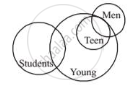
All the students are young. All the teens are young. Some men are teens.
Conclusions:
I. Some students are teens.
II. Some young are students.
III. Some young are men.
विकल्प
Only (I) follows
Only (II) and (III) follow
Only (I) and (II) follow
Only (I) and (III) follow
Advertisements
उत्तर
Only (II) and (III) follow
APPEARS IN
संबंधित प्रश्न
In this Question problem consists of a set of rules and facts. Apply the specified rules to the set of facts and answer the question. In answering the following question, you should not rely on any rule(s) except the rule(s) that are supplied for problem. Further, you should not assume any fact other than 'those stated in the problem. The aim is to test your ability to properly apply a rule to a given set of facts, even when the result is absurd or unacceptable for any other reason. It is not the aim to test any knowledge of law you may already possess.
Rule A: When a State undertakes any measure, the effects of the measure must be the same for all those who are affected by it.
Rule B: When a State undertakes any measure, everyone affected must have an equal chance to benefit from it.
Facts 100 mountaineers embarked on an extremely risky climbing expedition in Leh. Weather conditions worsened five days into the expedition and the mountaineers are trapped under heavy snow. The government received information on this tragedy only two weeks after the unfortunate incident and has only 24 hours in which to send rescue helicopters. Weather stations across the world confirm that this particular region of Leh will experience blizzards of unprecedented intensity for almost two weeks after this 24 hour window rendering any helicopter activity in the region impossible and certain death for anyone left behind. The government has only five rescue helicopters with a maximum capacity of 50 people (excluding pilots and requisite soldiers) and these helicopters can fly only once in 24 hours to such altitudes. As the Air Force gets ready to send the helicopters, an emergency hearing is convened in the Supreme Court to challenge this measure as this would leave 50 people to die. Choosing 50 survivors exclusively by a lottery would be:
In this Question problem consists of a set of rules and facts. Apply the specified rules to the set of facts and answer the question. In answering the following question, you should not rely on any rule(s) except the rule(s) that are supplied for problem. Further, you should not assume any fact other than 'those stated in the problem. The aim is to test your ability to properly apply a rule to a given set of facts, even when the result is absurd or unacceptable for any other reason. It is not the aim to test any knowledge of law you may already possess.
Rule A: When a State undertakes any measure, the effects of the measure must be the same for all those who are affected by it.
Rule B: When a State undertakes any measure, everyone affected must have an equal chance to benefit from it.
Facts 100 mountaineers embarked on an extremely risky climbing expedition in Leh. Weather conditions worsened five days into the expedition and the mountaineers are trapped under heavy snow. The government received information of this tragedy only two weeks after the unfortunate incident and has only 24 hours in which to send rescue helicopters. Weather stations across the world confirm that this particular region of Leh will experience blizzards of unprecedented intensity for almost two weeks after this 24 hour window rendering any helicopter activity in the region impossible and certain death for anyone left behind. The government has only five rescue helicopters with a maximum capacity of 50 people (excluding pilots and requisite soldiers) and these helicopters can fly only once in 24 hours to such altitudes. As the Air Force gets ready to send the helicopters, an emergency hearing is convened in the Supreme Court to challenge this measure as this would leave 50 people to die. If you were the judge required to apply Rule A, you would decide that:
Which of the following Acts of British Parliament envisaged for the first time a closer association of Indians with the administration?
For how long can the President's rule in a State-imposed initially?
Choose the most appropriate option:
The object of which one of the following writs is to prevent a person to hold public office which he is not legally entitled to hold?
Choose the most appropriate option:
Which Indian State has prescribed minimum educational qualification for candidates contesting panchayat polls?
Last week, the government used the Drug Price Control Order, 2013, to increase the price ceiling for 21 medicines by as much as 50% to ensure their availability in the market. This is a welcome move because lower prices would have further limited the availability of these drugs, some of which include those used for malaria, leprosy and allergy. The decision by the regulatory authority – usually known to reduce prices of essential drugs – was prompted by repeated petitions by the pharmaceutical industry, which pointed out that the increasing cost of imports had made the production of some of these drugs unviable. Prices of bulk drugs and active pharmaceutical ingredients have, in fact, gone up by up to 88%, and are largely imported.
This raises a basic question: Should the government control prices? The motivation for controlling drug prices is not very difficult to understand. Unlike some of the developed countries, where most of the population has insurance coverage or medical facilities are provided by the state, medical expenses in India are borne by citizens, largely through out-of-pocket expenses. Therefore, the state intervenes by keeping prices of some drugs in check to contain such spending. However, the unintended consequence is that it affects the supply of drugs and can potentially make citizens worse off. The risk of non-availability was an important reason for raising prices. Although all pharmaceutical companies may not stop producing drugs with price control, they may limit the supply. Further, the government usually dithers on price hike because of political considerations so that it is not accused of favouring private companies.
Thus, the government should stay away from dictating prices and allow the market to function. Competition in the marketplace will ensure that no company is able to make extraordinary profits in basic and essential drugs. Since the state has limited resources, it should focus on regulation, and ensure that the quality of drugs supplied in the market is not compromised at any point.
An essential medicine, ‘Formula A’, is used to treat cancer, and there is only one company engaged in its manufacture. If this is true, then, based on the author’s reasoning in the passage above:
Intellectual Property Rights (IPR) protect the use of information and ideas that are of
Read both the statements carefully and answer.
Assertion (A): No action lies for mere damage caused by some act which does not violate a legal right.
Reason (R): An action lies for interference with another's legal right even where it causes no actual damage.
Read both the statements carefully and answer.
Assertion (A): Custom to have the force of law must be followed from time immemorial.
Reason (R): Custom represents the common consciousness of the people.
