Advertisements
Advertisements
Question
Differentiate - Leading stand and lagging strand.
Advertisements
Solution
| Feature | Leading Strand | Lagging Strand |
| 1. Direction of synthesis | Synthesized continuously in the same direction as the replication fork. | Synthesized discontinuously in the opposite direction of the replication fork. |
| 2. Formation | Formed as a single, continuous strand. | Formed in short fragments called Okazaki fragments. |
| 3. Requirement of primers | Requires only one RNA primer to start synthesis. | Requires multiple RNA primers, one for each Okazaki fragment. |
| 4. DNA polymerase movement | Moves toward the replication fork. | Moves away from the replication fork. |
| 5. Speed of synthesis | Faster because it is continuous. | Slower because it is discontinuous. |
RELATED QUESTIONS
Explain the semi-conservative replication of eukaryotic DNA.
Which enzyme does remove supercoils from replicating DNA?
a) Identify the figure given below
b) Redraw the structure as a replicating fork and label the parts
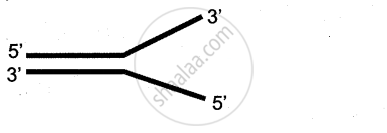
c) Write the source of energy for this replication and name the enzyme involved in this process.
d) Mention the differences in the synthesis of protein, based on the polarity of the two template strands.
Enzyme ______ brings about the DNA unwinding by breaking weak hydrogen bonds in the vicinity of origin.
At the point of origin, enzyme endonuclease nicks one of the strands of DNA by breaking the ______
"DNA is considered as genetic material" - Why?
Which of the following statement is incorrect?
Which of the following reaction is required for proofreading during DNA replication by DNA polymerase III?
In the experiment of Meselson and Stahl, the heavy DNA was separated from light DNA by centrifugation in ______.
Enzyme involved in synthesis of RNA primer.
