Advertisements
Advertisements
Question
Differentiate between cyclic and non-cyclic photophosphorylation.
Advertisements
Solution
| Cyclic photophosphorylation | Non-cyclic photophosphorylation | |
| 1. | Only Photosystem I is involved. | Both photosystems I and II are involved. |
| 2. | The electron given out by PS-I returns. | The electron given out by PS-II does return to it, but is used up by PS-I. |
| 3. | It is not associated with the photolysis of water, and so, oxygen is not liberated. | It is associated with the photolysis of water and the liberation of oxygen. |
| 4. | It involves only ATP synthesis. | It involves ATP synthesis and production of NADPH2. |
| 5. | It takes place under low light intensity, anaerobic conditions, or when CO2 availability is less. | It takes place under optimum light, aerobic conditions and the presence of CO2. |
| 6. | It does not participate in photosynthesis except in some bacteria and C4 plants. | It is concerned with CO2 fixation in all plants. |
APPEARS IN
RELATED QUESTIONS
Why do we often sneeze when we inhale a lot of dust-laden air?
Short answer question.
Why is it advantageous to breathe through the nose than through the mouth?
Identify the CORRECT statement.
Which of the following part becomes flat during inspiration?
During inspiration, the inter-costal muscles ____________.
Identify the role of NAD+ in cellular respiration
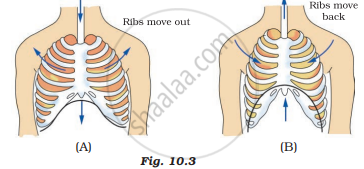
Observe the figures given in Figures 10.3 (A) and (B) and answer the following.
In the figure label the arrows and indicate the direction of
- movement of air
- movement of the diaphragm
- movement of ribs
Lungs do not collapse between breaths and some air always remains in the lungs which can never be expelled because ______.
Mark the true statement among the following with reference to normal breathing.
Identify the wrong statement with reference to the transport of oxygen.
