Advertisements
Advertisements
प्रश्न
Differentiate between cyclic and non-cyclic photophosphorylation.
Advertisements
उत्तर
| Cyclic photophosphorylation | Non-cyclic photophosphorylation | |
| 1. | Only Photosystem I is involved. | Both photosystems I and II are involved. |
| 2. | The electron given out by PS-I returns. | The electron given out by PS-II does return to it, but is used up by PS-I. |
| 3. | It is not associated with the photolysis of water, and so, oxygen is not liberated. | It is associated with the photolysis of water and the liberation of oxygen. |
| 4. | It involves only ATP synthesis. | It involves ATP synthesis and production of NADPH2. |
| 5. | It takes place under low light intensity, anaerobic conditions, or when CO2 availability is less. | It takes place under optimum light, aerobic conditions and the presence of CO2. |
| 6. | It does not participate in photosynthesis except in some bacteria and C4 plants. | It is concerned with CO2 fixation in all plants. |
APPEARS IN
संबंधित प्रश्न
The size of the chest cavity increases during inhalation.
Choose the correct alternative.
_______ muscles contract when the external intercostal muscles contract.
Explain the mechanism of breathing.
The Tidal Volume of a normal person is ______.
When 1500 mL air is in the lungs, it is called ______.
For which of the following reasons stepwise cellular respiration is useful?
Identify the CORRECT statement.
Assertion: During inhalation, the diaphragm goes downward.
Reason: The volume of the thoracic cavity decreases.
Which of the following is correct regarding pneumotoxic centres?
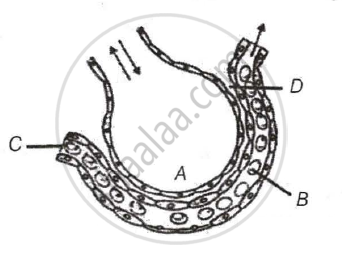
The figure given below shows a small part of human lung where exchange of gas takes place. In which one of the options given below, the one part A, B, C or D is correctly identified along with its function.